


Quick answer: The Mumbai-Ahmedabad bullet train is owned and managed by the National High Speed Rail Corporation Limited (NHSRCL). The actual civil construction is delivered by India’s largest EPC contractors, with Larsen and Toubro holding several of the biggest packages and firms such as Afcons taking on the difficult underground and undersea stretch near Mumbai. The trains run on Japanese Shinkansen technology, the funding leans heavily on a low-interest Japanese JICA loan, and most of the 508-kilometre corridor is delivered on an EPC contract basis.
Ask ten people who is building India’s first bullet train, and you will probably get ten different answers. Some will say Japan. Some will say Larsen and Toubro. Some will say the government. The truth is that all of them are partly right, and untangling who actually does what is one of the clearest lessons you can get in how giant infrastructure projects are really delivered.
This is not just trivia. The Mumbai-Ahmedabad High Speed Rail project, often shortened to MAHSR, is a working masterclass in ownership structures, EPC contracting, package strategy, procurement and risk. If you work in or want to enter the world of large projects, it pays to understand it properly.
Key takeaways
- NHSRCL owns and manages the project; EPC contractors such as Larsen and Toubro and Afcons do the building.
- The corridor uses an EPC model, which shifts design and construction risk onto contractors in return for price and schedule certainty.
- It runs about 508 kilometres on Japanese Shinkansen technology, at an estimated cost of around 1.1 lakh crore rupees, funded largely through a Japanese loan.
- The project was split into packages so several contractors could build in parallel.
- Early delays came mainly from land acquisition in Maharashtra, and momentum has since recovered.
- It is one of the best real-world case studies for anyone learning EPC project management, procurement and contracts.
Who is building India’s first bullet train?

The name to remember is NHSRCL. It is the special-purpose company, jointly owned by the central government and the participating state governments, that owns and drives the project from end to end.
Here is the part most people miss. NHSRCL does not lay a single metre of track itself. It plays the role of the owner, also called the employer or client, in contract language. Its job is to arrange funding, acquire land, set the technical standards, manage stakeholders and supervise delivery. The physical building is handed to contractors.
The owner, the builders and the technology partner
It helps to think of the project as a three-way partnership.
- The owner: NHSRCL, which plans, funds and supervises the corridor.
- The builders: Indian EPC contractors who design and construct defined stretches.
- The technology partner: Japanese organisations that supply the high-speed train sets, signalling and core systems, with significant funding through Japan.
So when someone asks who is building the bullet train, the accurate answer is a combination: an Indian owner, Indian construction firms, and Japanese high-speed rail technology, all working together under one large programme.
The main contractors are doing the heavy lifting.
The construction is split among several major firms. The most prominent include:
- Larsen and Toubro, which won several of the largest civil packages, covering long viaduct stretches, stations and track works across Gujarat and parts of Maharashtra.
- Afcons Infrastructure is associated with the demanding underground and undersea section near Mumbai, including a long tunnel beneath Thane Creek.
- Other established Indian contractors and joint ventures, handling additional civil packages, depots and supporting works along the alignment.
Japanese suppliers, meanwhile, provide the rolling stock based on the Shinkansen platform along with the signalling and train control systems that make true high-speed running possible.
Is the bullet train an EPC contract, and why does it matter?

Yes. The corridor is built largely on an Engineering, Procurement and Construction basis, and that single decision shapes almost everything about how the project runs.
Under an EPC model, one contractor takes a clearly defined scope and commits to a fixed price and a fixed schedule, then delivers a finished stretch ready to be used. For the owner, this brings two big advantages:
- Certainty. The price and timeline are agreed up front, which matters enormously on a project funded by a foreign loan.
- Single point accountability. One contractor owns the outcome for their package, which simplifies coordination and dispute resolution.
The trade-off is that the contractor carries the risk. If costs rise or problems appear, the contractor absorbs much of the impact. That is exactly why precise scope definition, careful contract drafting and fair risk allocation are so important. A vague EPC contract is a recipe for claims and disputes.
How the corridor was split into packages
Nobody builds 508 kilometres as a single contract. It would be impossible to manage and far too risky. So NHSRCL divided the route into a series of design and build packages so that several contractors could work in parallel.
The packaging logic looks something like this:
- Long civil packages for the elevated viaducts that carry most of the line
- Separate packages for major stations
- A dedicated package for the complex underground and undersea section near Mumbai
- Track, systems and depot packages layered on top
Each package was tendered competitively, evaluated on both technical capability and price, then awarded to the strongest qualified bidder. Deciding how to break a programme of this size into packages is genuinely strategic work, and it is one of the most valuable skills a procurement or contracts professional can develop.
What does the bullet train cost, and where does it run?

The headline cost figure sits in the region of 1.1 lakh crore rupees. A large share of that is funded through a low-interest loan from Japan under the JICA framework, which is one reason Japanese technology sits at the heart of the project.
The route and stations
The alignment runs from Mumbai up through Maharashtra and into Gujarat, ending in Ahmedabad. Along the way, it serves a series of stations in cities and towns, including Thane, Virar, Boisar, Vapi, Surat and Vadodara, among others.
Key features of the route include:
- A corridor of roughly 508 kilometres
- A series of stations designed for high-speed boarding
- Mostly elevated viaducts to keep the line clear of road and rail crossings
- A notable undersea tunnel section near Mumbai that has drawn significant engineering attention
The trains and technology
The train sets are based on the Japanese Shinkansen platform, a system with decades of high-speed service behind it and an almost spotless safety record. The design supports high operating speeds that will cut the Mumbai to Ahmedabad journey dramatically compared with conventional rail. There is also a strong technology transfer and local manufacturing angle, in line with India’s wider push to build capability at home.
When will the Mumbai-Ahmedabad bullet train be ready?
In phases, not all at once. The plan has long been to open early operational stretches in Gujarat first, with the full corridor following over the following years as remaining civil and systems work is completed.
It is worth being honest about the delays. Land acquisition in Maharashtra slowed the early years of the project considerably, which is a familiar story on big Indian infrastructure schemes. Once those hurdles eased, momentum recovered strongly, and construction is now visible across both Gujarat and Maharashtra. Exact dates have shifted over time, so the sensible expectation is a phased opening rather than a single grand launch.
Why this project is a goldmine for EPC professionals
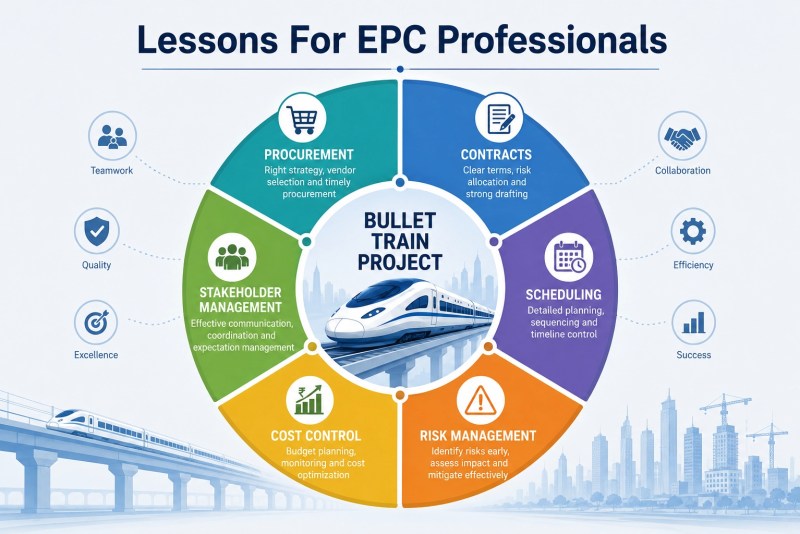
Strip away the headlines, and the bullet train is a living textbook. Almost every lever that decides whether a major project succeeds or fails is on display here:
- Scope and package strategy: how the corridor was divided to manage risk and speed up delivery
- Procurement and tendering: how contractors were qualified, evaluated and selected
- Contract drafting and risk allocation: how responsibility was shared under EPC terms
- Schedule and cost control: how parallel construction is coordinated across many fronts
- Stakeholder and land management: how delays were handled, and momentum recovered
The engineers who understand these levers are the ones who end up leading projects rather than simply working on them. That gap between technical knowledge and project leadership is precisely where focused training makes the difference.
Where RKS Trainings fits in
RKS Trainings was built for exactly this audience. The courses are practitioner-led and aimed squarely at engineers and construction professionals, not the generic IT style certifications you find elsewhere. You can dig into EPC contract management, FIDIC contracts, Primavera P6 scheduling, risk management and procurement, which are the same disciplines that keep a project like the bullet train on track.
The teaching stays practical and grounded in real project situations, because that is what employers actually reward. If you want to build a career around work of this scale, whether in India or on similar high-speed and infrastructure projects abroad, that kind of structured, real-world training is a strong place to start.
FAQs
Who is building the Mumbai-Ahmedabad bullet train?
NHSRCL owns and manages the project, while leading Indian EPC contractors such as Larsen and Toubro and Afcons handle the civil construction. Japanese partners supply the high-speed trains and signalling technology behind the corridor.
Is the bullet train project an EPC contract?
Yes, the corridor is delivered largely on an Engineering, Procurement and Construction basis. Contractors take single point responsibility for designing and building defined packages within fixed scope, price and schedule terms agreed with NHSRCL.
What is NHSRCL in the bullet train project?
NHSRCL is the National High Speed Rail Corporation Limited, the special purpose company that owns, funds and manages India’s bullet train corridor between Mumbai and Ahmedabad on behalf of the central and state governments.
How long is the Mumbai-Ahmedabad high-speed rail corridor?
The corridor runs roughly 508 kilometres between Mumbai and Ahmedabad, passing through cities such as Surat and Vadodara. It sits mostly on elevated viaducts, with a significant undersea tunnel section near the Mumbai coast.
How much does India’s bullet train project cost?
The estimated cost is around 1.1 lakh crore rupees, funded substantially through a low-interest loan from Japan under the JICA framework, alongside contributions from the participating central and state governments.
Which technology powers the bullet train?
The project uses proven Japanese Shinkansen technology, known for very high operating speeds, advanced signalling and a long safety record. It is being adapted by Indian and Japanese partners for local conditions and manufacturing.
When will the bullet train start running?
Operations will begin in phases. Early stretches in Gujarat are expected to open first, with the full Mumbai to Ahmedabad service following over subsequent years as the remaining civil and systems work is completed.
Why was the bullet train delayed?
Early progress was slowed mainly by land acquisition challenges in Maharashtra, a common issue on major Indian infrastructure projects. Construction momentum has since recovered strongly across both Gujarat and Maharashtra.
What can EPC professionals learn from the bullet train project?
It demonstrates package strategy, procurement, contract drafting, risk allocation and schedule control in real conditions. These are the exact competencies that structured EPC project management training develops for engineers and construction professionals.
Where can I learn EPC project management for projects like this?
RKS Trainings offers practitioner-led EPC project management, FIDIC contracts, Primavera P6 and procurement courses for engineers and construction professionals who want to work on major infrastructure projects in India and abroad.