


Key takeaways:
- Poor contract management increases EPC project costs by 8 to 15 percent due to unmanaged disputes, claims, and delays.
- Contract leakage occurs when variation orders go unclaimed or liquidated damages are not enforced, and it is one of the most overlooked financial risks in EPC projects.
- Variation orders must follow a formal written approval process before work begins. Verbal approvals are unenforceable and cause cost recovery failures.
- EPC contract document management requires a centralized register, correspondence log, and version control system to prevent missed notices and invalid claims.
- Clear risk allocation in the EPC contract defines who bears cost, schedule, and performance consequences when uncertain events occur.
Contract management is one of the most critical functions in large infrastructure and construction projects, especially in Engineering, Procurement, and Construction (EPC) projects. It ensures that all contractual obligations between project stakeholders are clearly defined, executed properly, and monitored throughout the project lifecycle.
In EPC projects, contracts govern every major activity, including engineering design, procurement of equipment, construction execution, and project delivery. Because these projects involve multiple stakeholders such as contractors, subcontractors, suppliers, consultants, and clients, effective Contract Management in EPC Projects is essential to avoid disputes, delays, and financial losses.
Studies in the construction industry show that poor contract management can increase project costs by 8–15% due to disputes, claims, and delays. A structured contract management process helps organizations track obligations, manage risks, ensure compliance, and maintain transparency between project parties.
This practical guide explains EPC contract management, the contract lifecycle, contract administration practices, risk management strategies, and how modern AI tools such as ChatGPT, Claude, and Perplexity AI can support contract managers in analyzing agreements and identifying potential risks.
Table of Contents
What is Contract Management?

Contract management is the process of creating, negotiating, executing, monitoring, and enforcing contracts between project stakeholders to ensure that all parties fulfill their contractual obligations.
In large engineering and construction projects, contracts define the responsibilities, timelines, technical requirements, and financial terms agreed upon by the parties involved.
Effective contract management ensures that:
- contractual obligations are clearly defined
- Project risks are allocated appropriately
- performance standards are maintained
- disputes are minimized
The contract management process continues throughout the entire project lifecycle, from contract drafting to final project completion.
Why is Contract Management Important in EPC Projects?
Contract management in EPC projects ensures that all contractual agreements are implemented correctly and that project stakeholders comply with the agreed terms and conditions.
EPC projects typically involve high-value contracts and complex responsibilities. A single project may include multiple contracts for engineering services, equipment supply, construction activities, and subcontracting work.
Effective contract management provides several benefits:
- improved project cost control
- better risk allocation between stakeholders
- reduced legal disputes
- stronger supplier and contractor accountability
- improved project performance
Because EPC projects involve multiple contracts and stakeholders, managing contractual obligations effectively becomes essential for project success.
What is the Contract Management Process?

The contract management process refers to the structured sequence of activities used to manage contracts throughout their lifecycle.
This process ensures that contracts are properly negotiated, implemented, monitored, and closed after project completion.
Major Stages of the Contract Management Process
| Stage | Description |
|---|---|
| Contract Planning | Define project requirements and contract strategy |
| Contract Drafting | Prepare legal and technical contract documents |
| Negotiation | Discuss contract terms with stakeholders |
| Contract Execution | Sign and implement the contract |
| Performance Monitoring | Track contractor performance |
| Contract Modification | Manage contract changes and variations |
| Contract Closure | Finalize the contract after project completion |
Organizations often use digital contract management systems to track contractual obligations and maintain documentation.
What are the Key Phases of EPC Contract Management?
EPC contract management involves multiple phases that ensure contracts are implemented correctly throughout the project lifecycle.
Contract Planning
Contract planning defines the overall contracting strategy for the project.
Activities in this phase include:
- defining contract scope
- selecting contract types
- identifying contractual risks
- preparing procurement strategies
Proper planning helps avoid ambiguity in contract terms.
Contract Drafting
Contract drafting involves preparing the legal and technical documents that define the contract.
A typical EPC contract includes:
- scope of work
- project timeline
- payment conditions
- performance guarantees
- dispute resolution mechanisms
Clear drafting helps reduce misunderstandings between project stakeholders.
Contract Negotiation
Negotiation is the process of discussing and finalizing contract terms between the parties involved.
Negotiation usually covers:
- pricing structure
- risk allocation
- delivery schedules
- liability conditions
Effective negotiation ensures that both parties agree on fair and realistic contract terms.
Contract Execution
Contract execution occurs when both parties formally sign the contract and begin implementing the agreed obligations.
At this stage, project teams begin coordinating engineering, procurement, and construction activities according to contract conditions.
Contract execution marks the official start of the project contract lifecycle.
Role of the EPC Contract Manager
The EPC contract manager oversees all contractual obligations throughout the project lifecycle, focusing on commercial and legal compliance rather than technical execution.
Key responsibilities include:
- Tracking contractual obligations and milestone deadlines
- Managing formal correspondence and notice submissions
- Processing variation orders and extension of time claims
- Maintaining the contract document register
- Monitoring performance against contract KPIs
In large EPC projects, the contract manager bridges the commercial team, legal team, and execution team. Without this role clearly defined, obligations go untracked and disputes escalate.
EPC Contract Scope of Work and Change of Scope
The scope of work in an EPC contract defines exactly what the contractor must design, procure, and construct. A poorly defined scope is the single most common source of disputes in EPC projects.
A well-drafted EPC contract scope of work must include:
- Detailed technical specifications and engineering standards
- Equipment lists with performance parameters
- Interface definitions and site boundaries
- Clearly stated exclusions
- Testing and commissioning requirements
Change of scope in EPC contracts occurs when actual work requirements differ from what was originally contracted. All scope changes must be managed through a formal variation order. Verbal approvals are not enforceable and lead to cost recovery failures.
Variation Order Management in EPC Projects
Variation order management is one of the most critical functions in large EPC projects. Uncontrolled change orders across multiple contracts are among the top causes of cost overruns and schedule delays.
Variation Order Process
- Identification – Change is formally notified in writing
- Assessment – Contractor evaluates cost and schedule impact
- Submission – Variation proposal submitted with supporting documents
- Approval – Both parties agree and sign before work proceeds
- Record update – Contract register, schedule, and budget baseline updated
For projects managing multiple contracts simultaneously, a centralized variation register is essential to track cumulative impacts on budget and completion date.
Schedule Responsibility and Progress Management in EPC Contracts
Schedule responsibility in an EPC contract defines which party owns specific milestones, what constitutes a delay, and how extensions of time are applied.
Key elements include:
- Baseline schedule – The agreed reference point for all delay analysis
- Progress reporting – Weekly and monthly reports covering physical progress and procurement status
- Extension of time (EOT) – Claimed when delays result from owner actions or force majeure, supported by formal documentation
- Liquidated damages (LD) – Applied when contractor-caused delays push completion beyond the contract date
Clearly defined schedule responsibility significantly reduces delay disputes in EPC projects.
EPC Contract Document Management
EPC contract document management is the process of organizing, controlling, distributing, and archiving all contract-related documents throughout the project lifecycle.
Without structured document management, critical contractual notices are missed, version control fails, and claims are rejected on procedural grounds rather than merit.
Key elements of EPC contract document management:
- Document register – Centralized log tracking all contract documents and revision status
- Correspondence register – Log of all formal correspondence with response deadlines
- Version control – Ensures only approved document versions are in use
- Audit trail – Retrievable document history for dispute support and closeout
Every contractually significant communication must be written, filed, and traceable. A missed notice deadline can invalidate a valid claim regardless of its commercial merit.
Contract Leakage in EPC Projects
Contract leakage is the financial loss that occurs when contractual entitlements are not tracked or enforced. It is one of the most overlooked risks in EPC project delivery.
Common causes of contract leakage:
- Variation orders performed but never formally submitted
- Extensions of time not claimed despite valid owner-caused delays
- Liquidated damages not applied when contractors miss milestones
- Retention not released after the defect liability period expires
- Subcontract terms not aligned with the main EPC contract
How to Prevent Contract Leakage
- Maintain a live obligation tracker listing every contractual right and deadline
- Conduct monthly contract health checks to identify untracked entitlements
- Train the project team to recognize commercially significant contractual events
For the commercial dimension of this topic, see our guide on commercial management in EPC contracts.
Contract Monitoring and Administration
Contract monitoring ensures that all parties comply with the contract terms.
Contract managers monitor:
- contractor performance
- milestone completion
- payment schedules
- compliance with specifications
Contract administration also includes managing communication between project stakeholders.
Contract Modification and Change Management
During project execution, contract changes may occur due to design modifications, scope changes, or unforeseen conditions.
Contract managers must document and approve changes through formal variation orders.
Proper change management helps avoid contract disputes and cost overruns.
Contract Closure
Contract closure occurs after all contractual obligations have been fulfilled.
Activities in this phase include:
- final inspections
- final payment processing
- contract documentation archiving
- performance evaluation
Contract closure ensures that the project is completed according to contractual requirements.
How Contract Management Works in Construction Projects

Contract management in construction involves monitoring contractual performance during the project execution phase.
Construction projects involve multiple contracts, including:
- EPC main contract
- subcontractor agreements
- equipment supply contracts
- engineering consultancy agreements
Contract managers ensure that:
- contractors meet technical specifications
- project milestones are achieved
- Payments are processed correctly
- Disputes are resolved efficiently
Construction contract management requires continuous coordination between project managers, legal teams, procurement teams, and contractors.
Common Types of EPC Contracts

Different types of contracts are used depending on project structure, risk allocation, and project complexity.
Lump Sum EPC Contract
In a lump sum contract, the contractor agrees to deliver the entire project for a fixed price.
This contract type provides cost certainty for the project owner.
Cost Plus Contract
In a cost-plus contract, the contractor is reimbursed for actual project costs plus an additional fee or profit margin.
This type of contract is often used when the project scope is uncertain.
Unit Price Contract
In a unit price contract, payment is based on the quantity of work completed.
This approach is common in infrastructure and construction projects.
Selecting the appropriate contract type is an important part of the contract management strategy.
How AI Tools Can Support Contract Management
Artificial intelligence is increasingly helping organizations analyze and manage complex contracts.
AI tools can assist contract managers in reviewing large legal documents and identifying important clauses.
Example AI Applications in Contract Management
Contract managers can use ChatGPT to:
- explain complex contract clauses
- draft contract summaries
- generate contract communication emails
AI assistants such as Claude can:
- summarize long agreements
- Highlight risk clauses
- Extract key obligations from contracts
Research tools like Perplexity AI can help teams review contract law updates and industry standards.
AI-powered contract analysis tools help organizations reduce legal risks and improve contract transparency.
What Are the Common Contract Risks in EPC Projects?
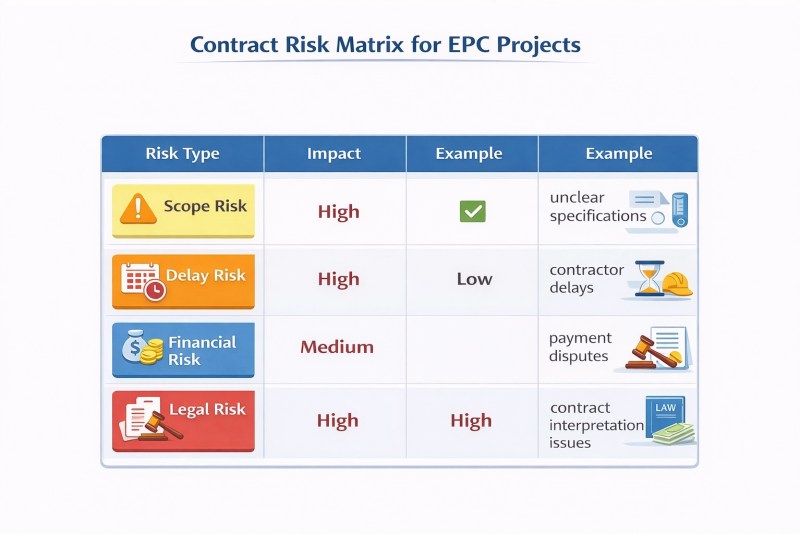
Contract risks can significantly impact project outcomes if they are not properly managed.
Common risks in EPC contracts include:
- unclear scope definitions
- payment disputes
- contractor delays
- design responsibility conflicts
- regulatory compliance issues
Poorly defined contracts often lead to disputes and claims during project execution.
Strong contract management practices help mitigate these risks and ensure project stability.
Best Practices for Effective Contract Management
Organizations can improve contract performance by following proven contract management practices.
Establish Clear Contract Documentation
Contracts should clearly define scope, responsibilities, and deliverables.
Maintain Transparent Communication
Open communication between stakeholders helps prevent misunderstandings.
Monitor Contract Performance
Regular performance monitoring ensures contractors comply with project requirements.
Implement Strong Change Management
All contract changes should be documented and approved through formal processes.
Use Digital Contract Management Systems
Contract management software helps organizations track obligations, documents, and performance metrics.
Conclusion
Contract management in EPC projects is the discipline that protects project outcomes, controls costs, and reduces disputes from contract award through to final closeout.
A structured approach covering variation order management, document control, schedule responsibility, contract leakage prevention, and clear risk allocation gives EPC teams the tools to deliver projects within agreed terms.
About the Author: This guide was written by Rajeev Sharma, B.E. (Mech), PGDM, with 25+ years of hands-on EPC contract and commercial management experience. Rajeev leads RKS Trainings, delivering specialized training and consulting services for EPC contractors and project owners.
Explore our EPC Contract Management Training program designed for contract managers, project engineers, and commercial professionals.
Read: Contract Administration in Construction and EPC Projects
Top EPC Project Risks and How to Manage Them
Commercial Management in EPC Contracts
How to Draft Strong EPC and Construction Contracts
Frequently Asked Questions
What is contract management in EPC projects?
Contract management in EPC projects is the process of creating, executing, monitoring, and enforcing agreements between the project owner, contractor, and subcontractors to ensure all obligations are fulfilled throughout the project lifecycle.
What is EPC contract document management?
EPC contract document management is the structured process of organizing, version-controlling, and archiving all contract documents and correspondence to ensure traceability, prevent missed notices, and support audit readiness across project phases.
What is contract leakage in EPC projects?
Contract leakage is the financial loss that occurs when contractual entitlements such as variation orders, extensions of time, or liquidated damages are not tracked or enforced throughout EPC project execution.
What does an EPC contract manager do?
An EPC contract manager oversees contract compliance, manages variation orders, processes extension of time claims, maintains correspondence logs, and ensures all contractual obligations and notice deadlines are tracked throughout project execution.
What is variation order management in EPC projects?
Variation order management is the formal process of identifying, assessing, documenting, and approving all changes to EPC contract scope, schedule, or price before changed work is executed on site.
How does change of scope work in an EPC contract?
Change of scope occurs when work requirements differ from the original contract. All scope changes must be formally agreed through a signed variation order before work proceeds. Verbal approvals are unenforceable.
What is schedule responsibility in an EPC contract?
Schedule responsibility defines which party owns specific milestones, what constitutes a contractor-caused versus owner-caused delay, and how extensions of time and liquidated damages are applied during project execution.
What is EPC contract risk allocation?
EPC contract risk allocation assigns specific project risks to the owner or contractor based on who is best placed to manage them. The FIDIC Silver Book allocates maximum cost, schedule, and performance risk to the EPC contractor.
How do you prevent contract leakage in EPC projects?
Prevent contract leakage by maintaining a live obligation tracker, conducting monthly contract health checks, ensuring all variation orders are formally submitted, and training the team to recognize commercially significant contract events.
What are the common types of contracts in EPC project management?
Common EPC contract types include lump sum fixed-price contracts, cost-plus contracts, and unit price contracts. The FIDIC Silver Book is the standard framework for lump sum EPC turnkey projects internationally.