

Key Takeaways
- Learning how to draft construction contracts starts with zero ambiguity scope definition before addressing any other contractual provision.
- Key clauses in construction contracts include scope, payment terms, risk allocation, variations, indemnity, liability caps, and dispute resolution.
- Construction contract drafting best practices require clear, balanced, enforceable language that both parties genuinely understand and can execute.
- Risk allocation in construction contracts should always assign each risk to the party best positioned to control and manage it.
- Construction contract negotiation strategies focus on fair risk trading, not winning every clause or forcing one-sided positions.
- Drafting EPC construction contract clauses requires single-point responsibility language covering design, procurement, construction, and guaranteed performance.
- Common drafting mistakes in construction contracts include undefined interfaces, vague scope, missing time bars, and unenforceable liquidated damages clauses.
- A construction contract negotiation checklist covering scope, payment, risk, changes, liability, disputes, termination, and insurance prevents costly oversights.
- FIDIC contract drafting and negotiation requires careful customization through Special Conditions because standard General Conditions rarely fit every project.
- How to negotiate contract terms effectively means understanding the other party’s commercial drivers and trading concessions strategically on priority clauses.
The conference room went silent. Two companies had just spent six months negotiating a $200 million construction contract. Everything seemed perfect. Both sides signed.
Three months into construction, the fights began. The contractor claimed additional work. The client refused payment. Each side pulled out the contract. Each side insisted they were right.
The contract supported both positions. Because it was poorly drafted.This is a practical construction contract drafting guide built from real project experience. Not legal theory.
Table of Contents
What Makes a Construction Contract “Strong”?
Strong does not mean aggressive or one-sided. Strong means clear, enforceable, and balanced enough that both parties can execute confidently.
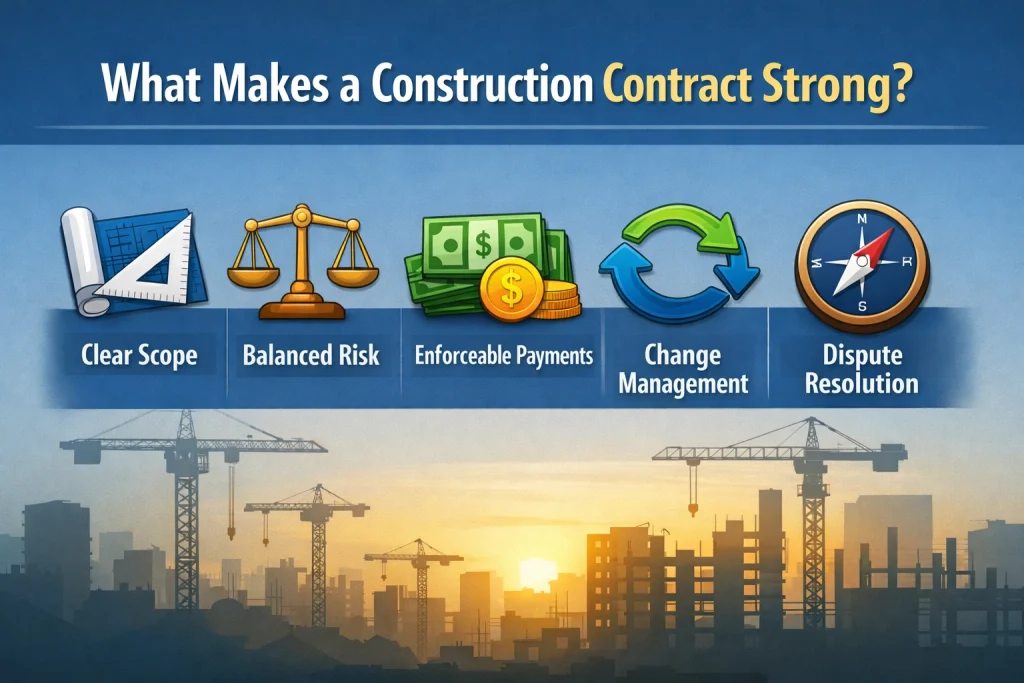
Clear scope means everyone knows exactly what is included, excluded, and required. Balanced risk allocation means risks go to the party best able to control them. Enforceable payment terms mean nobody wonders when they get paid or how much. Defined change management means every modification follows a documented process. Predictable dispute resolution means when disagreements arise, a clear fair path exists.
Aggressive contracts do not work. Load all risk on the contractor and they price it high or cut corners. Include penalty clauses that are clearly unfair and courts strike them down. Clarity beats aggression every time.
How to Draft Construction Contracts: Step-by-Step Guide
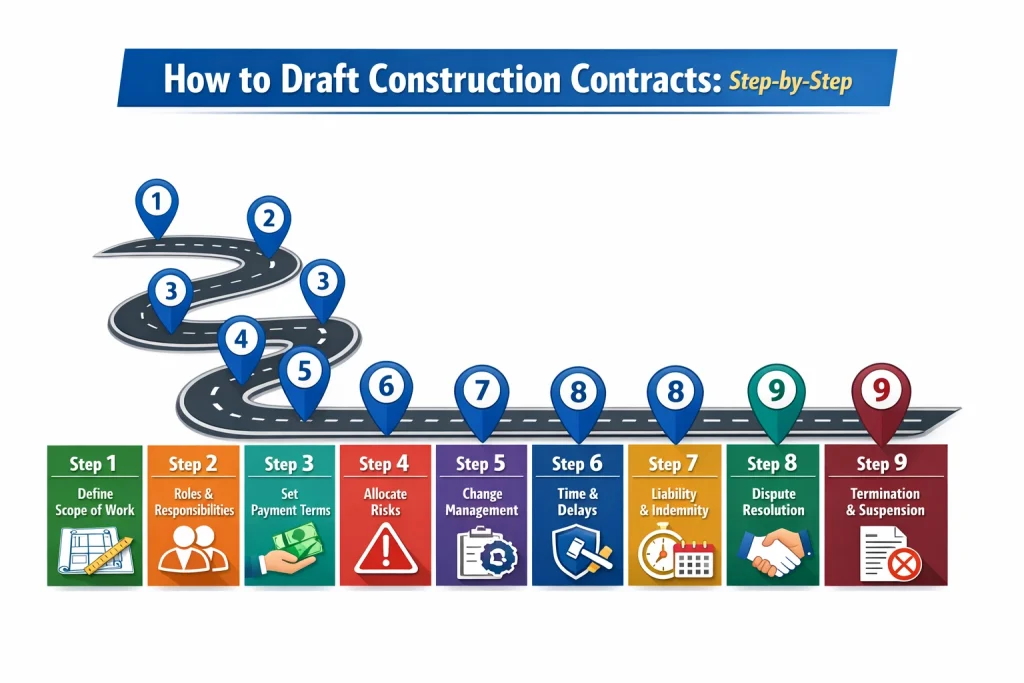
Let me walk through drafting contracts that work.
Step 1: Draft a Clear Scope of Work
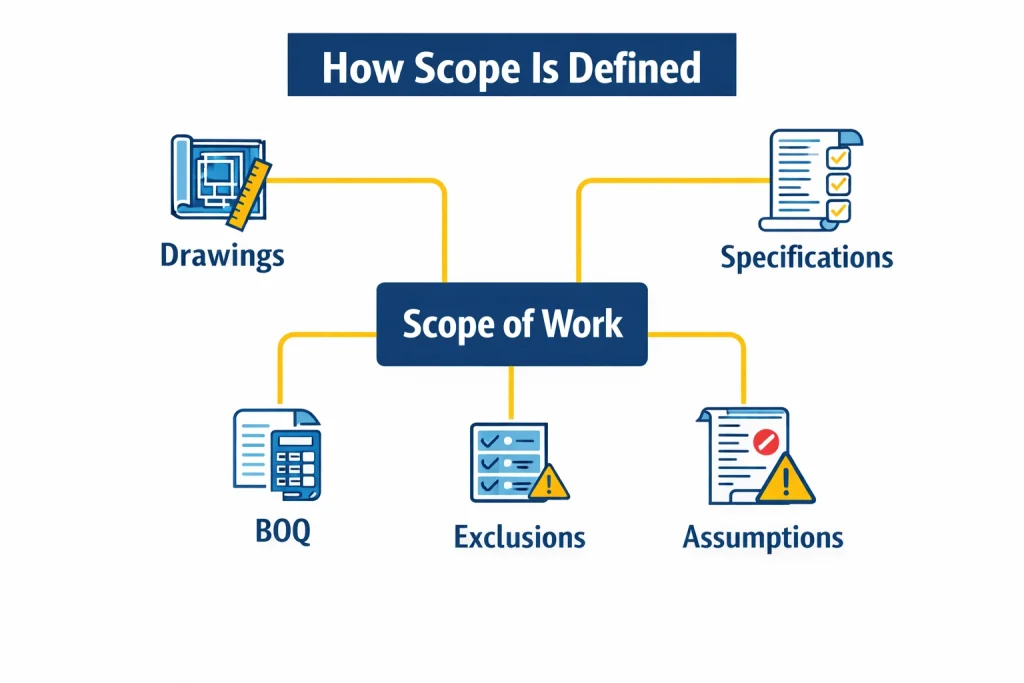
Understanding drafting scope of work for construction contracts is where everything starts and where most contracts fail. Vague scope causes more disputes than everything else combined.
Use multiple definition methods together. Reference specific drawing numbers and revisions. Write detailed specifications with material standards and quality requirements. Use Bills of Quantities where appropriate but state explicitly whether quantities are binding or approximate in lump-sum contracts.
List exclusions explicitly. “This contract excludes connection to existing utilities beyond the site boundary, removal of contaminated soil, and obtaining environmental permits.” List assumptions too. If they prove wrong, you have grounds for adjustment.
The test of good scope: give the contract to an engineer who does not know the project. If they cannot understand exactly what needs to be built, your scope is unclear. Fix it before signing.
Step 2: Define Roles, Responsibilities and Interfaces
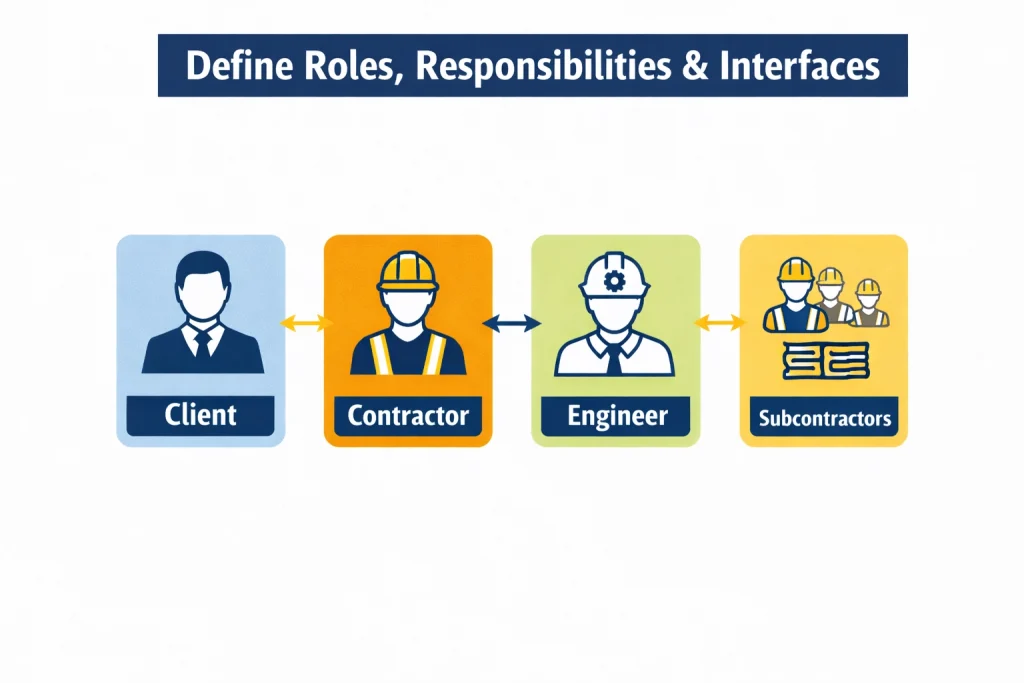
Define every party’s responsibilities in writing. State client deadlines for site access, permits, and information provision. Specify that contractor performance includes design if applicable, procurement, construction, testing, commissioning, training, and handover documentation.
Interface risks deserve specific attention. Where different work packages meet, problems happen. Define battery limits, mechanical-electrical interfaces, and civil-structural interfaces explicitly. State who coordinates, who resolves interface problems, and who pays for fixing them.
Define authority levels clearly. Only named and authorized individuals can issue instructions binding on the contractor. This prevents junior staff from creating commitments that management later refuses to honor.
Step 3: Draft Payment Terms That Actually Work
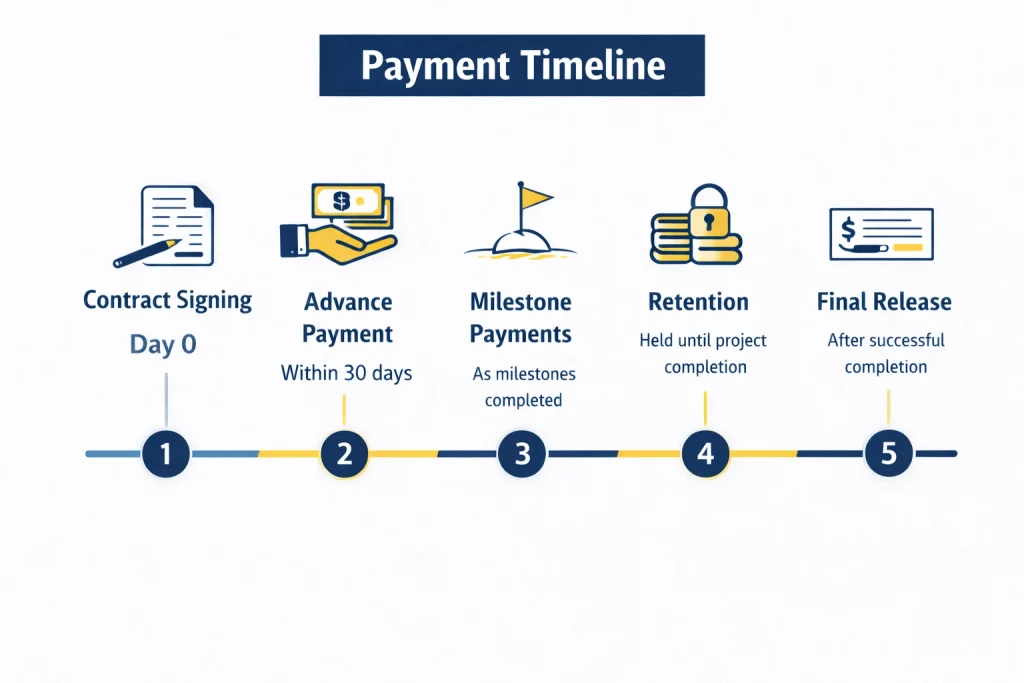
How to draft payment terms construction professionals rely on requires choosing the right payment model first. Lump sum gives clients cost certainty. Item rates suit uncertain quantities. Milestone-based lump sum combines certainty with cash flow management and works best for most projects.
Define milestones objectively. Not “substantial progress” but “foundation concrete for all structures completed and cured, certified by Engineer.” Set specific milestone values as percentages of contract price.
Address advance payments with clear security requirements. Set retention at 5 to 10 percent per payment certificate. Define certification timelines precisely. “Contractor submits application by the 25th. Engineer certifies within 14 days. Client pays within 28 days of certification.” Late payment should trigger suspension rights and interest obligations.
Step 4: Risk Allocation in Construction Contracts
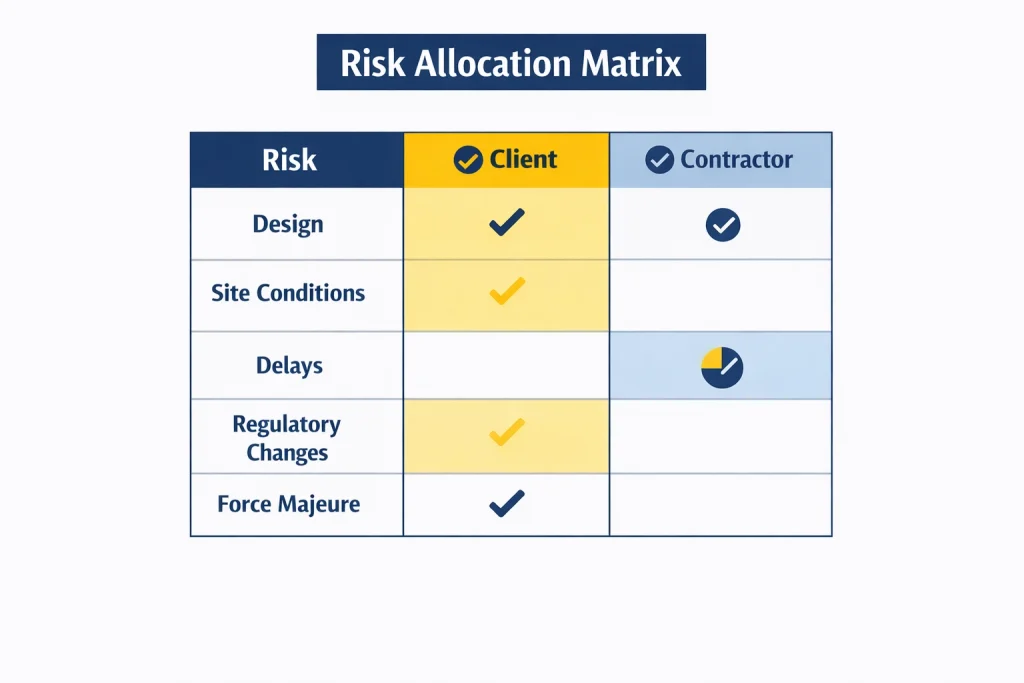
consequences when things go wrong. Ambiguity here causes most major disputes.
Design risk goes to whoever controls design. If the employer provides it, they bear design risk. If the contractor designs, they bear it entirely. State this explicitly in every contract.
Site condition risk requires a balanced approach. The client provides geotechnical data. If actual conditions materially differ from that data in ways a competent contractor could not have anticipated, the contractor gets relief. This is fair because the client controlled the site investigation.
Force majeure events entitle the contractor to time relief but not additional payment. Changes in law after contract date are usually employer risk. Create a risk allocation matrix as a contract schedule. This forces both parties to think through every risk during negotiation and prevents expensive assumptions later.
Step 5: Drafting Change Order and Variation Clauses
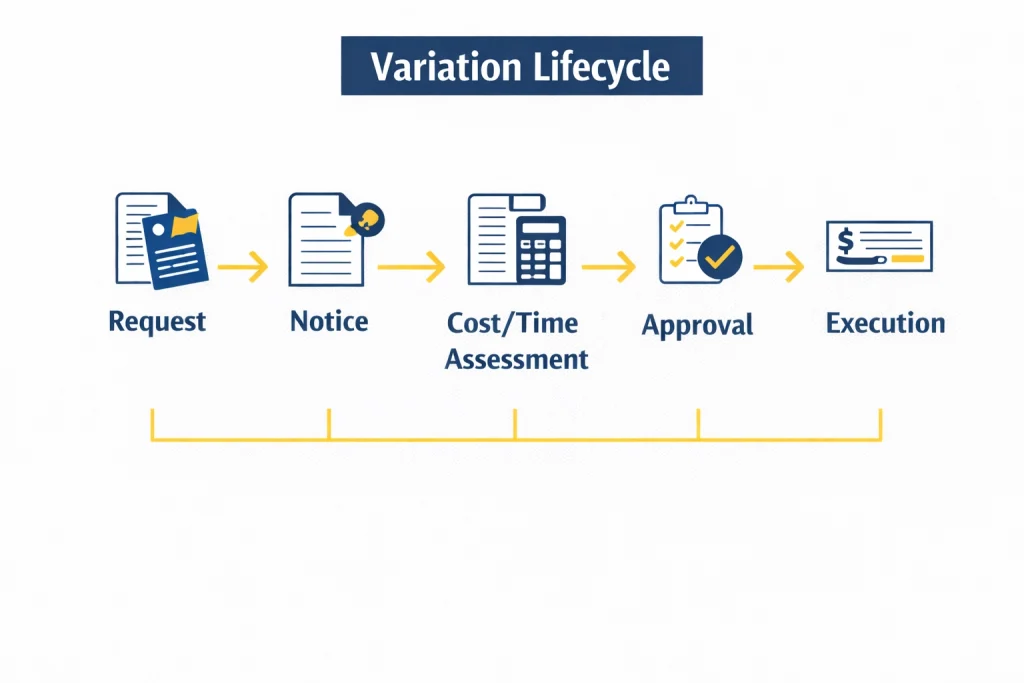
Change order clause language requires defining what constitutes a change, who can request one, and exactly how it gets processed and approved.
Define a variation as any deviation from contract scope including client requests, differing site conditions, and regulatory changes. Require written notice of any claimed variation within 14 days. Set out the full procedure: variation request issued, contractor assesses cost and time impact within 14 days, proposal submitted, client reviews and negotiates, both parties sign before work proceeds.
Define pricing priority. Try agreed lump sum first. Fall back to contract rates. Last resort is cost-plus with agreed markup. Every variation order must state both the price adjustment and the completion date adjustment.
No work proceeds without signed written authorization. Verbal instructions do not count. I worked on a project where a site engineer verbally instructed changes totaling millions. The client said no authorization existed. Require writing. Always.
Step 6: Drafting Time, Delay and Liquidated Damages Clauses
Define completion specifically. Not “substantial completion” without a definition. “Completion means all works constructed per contract documents, all systems tested and commissioned, all certifications obtained, and Taking-Over Certificate issued.”
Define the Extension of Time mechanism clearly. Contractor gives notice within 7 days of the delaying event and submits an EOT claim within 28 days including critical path impact analysis.
Liquidated damages must be genuine pre-estimates of actual loss, not penalties. State a daily rate and a maximum cap. “LDs of $25,000 per day up to a maximum of 10 percent of Contract Price.” Courts strike down unlimited or disproportionate LDs. Caps make them enforceable.
Step 7: Drafting Indemnity and Liability Clauses
Negotiation indemnity and liability clauses requires understanding what can and cannot be capped.
Set reasonable total liability caps. “Contractor’s total liability shall not exceed 100 percent of Contract Price except for death, personal injury, fraud, and willful misconduct.” Exclude consequential damages including lost profits and business interruption because they are unpredictable and make contracts uninsurable.
Back every indemnity with adequate insurance. Require general liability, professional indemnity for design, workers compensation, and construction all-risks coverage. Require proof before work starts. Name the client as additional insured on relevant policies.
Step 8: Drafting Dispute Resolution Clauses
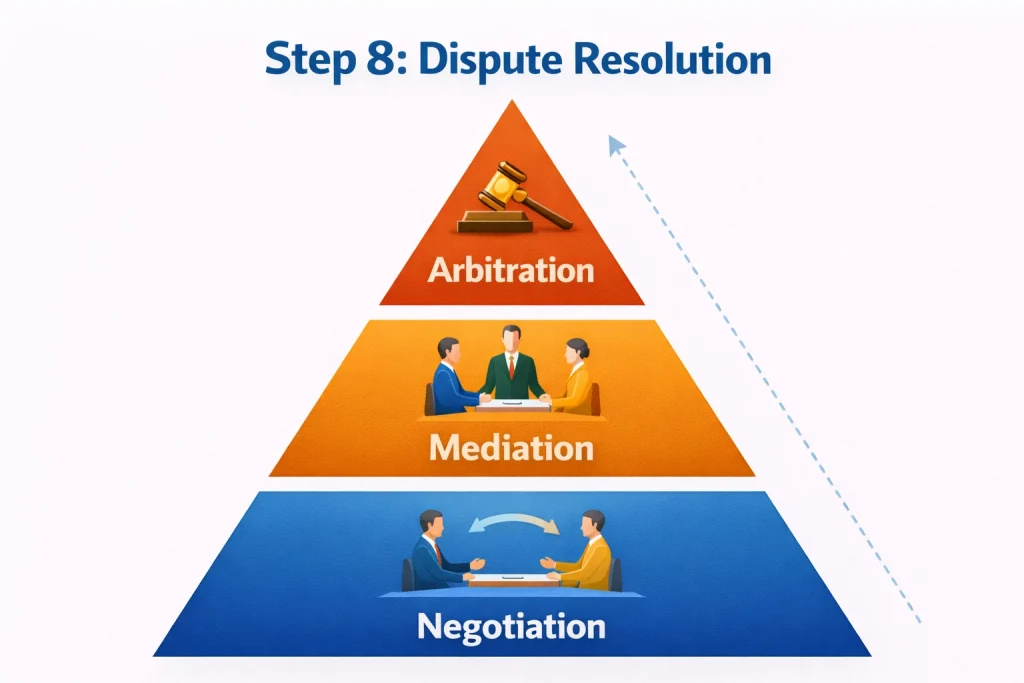
Drafting dispute resolution clauses requires building a multi-tier hierarchy that prevents jumping straight to expensive arbitration.
Tier one is project-level negotiation giving managers 14 days. Tier two is senior management review with 14 to 21 days. Tier three is mediation with a neutral facilitator over 30 to 60 days. Tier four is adjudication by an independent expert producing a binding but challengeable decision. Tier five is final binding arbitration under ICC, LCIA, or SIAC rules.
State arbitration rules, number of arbitrators, seat, and language explicitly. Specify governing law. Parties shall not commence arbitration until completing tiers one through four.
Step 9: Drafting Termination and Suspension Clauses
Define termination for contractor default covering insolvency, abandonment, persistent failure to proceed, and unremedied breach within 14 days of notice. Define termination for client default covering non-payment of undisputed amounts within 60 days.
Termination for convenience allows the client to exit without default but requires compensating the contractor for work done, reasonable profit on incomplete work, and demobilization costs. Negotiate compensation terms carefully because clients need this right but contractors need fair payment when it is exercised.
How to Negotiate Construction Contracts Effectively
Construction contract negotiation strategies start with changing your mindset. Negotiation is not about winning clauses. It is about pricing risk correctly and finding terms both sides can live with.
Understand commercial drivers. Clients want cost certainty, schedule certainty, and single-point accountability. Contractors want fair payment terms, protection from uncontrollable risks, and clarity for accurate pricing. Understanding motivations helps find solutions that work for everyone.
Prioritize critical clauses and be flexible elsewhere. Fighting every single clause exhausts both parties and kills deals. Trade risks instead of deleting them. Offer a compromise allocation rather than simply refusing a risk clause.
Document every negotiated position after each meeting. Circulate minutes within 48 hours. Both parties initial contract markups. By signing time there should be no surprises.
Key Clauses to Focus on During Negotiation
Not all clauses matter equally. Focus on these:
Scope and exclusions. What’s in, what’s out. This drives everything else. Get it clear.
Payment and cash flow. When does money flow? What are milestone values? Advance payment amounts? Retention? Payment timelines?
Contractors live or die on cash flow. Clients want control over payment for leverage.
Find balance.
Risk allocation. Who takes design risk, site risk, delay risk, and regulatory risk?
This has huge pricing implications. Allocate risks to parties best able to control them.
Variations and claims. How are changes handled? What notice is required? How are changes priced?
Poor variation procedures cause endless disputes. Get them right.
Indemnity and liability. What’s the contractor’s maximum exposure? What’s excluded? What insurance backs the indemnities?
Contractors can’t accept unlimited liability. Clients need adequate protection.
Negotiate caps and insurance levels that make sense.
Termination. Under what circumstances can either party terminate? What compensation applies?
This is the escape hatch. Make sure it’s fair but not easily abused.
Construction Contract Negotiation Checklist
Here’s a practical checklist for negotiation:
| Area | Key Questions |
|---|---|
| Scope | Is anything assumed but not explicitly written? Are exclusions clear? |
| Payment | When do I actually get paid? Are milestones objective? Is cash flow manageable? |
| Risk | Who bears delay risk? Site condition risk? Design risk? |
| Changes | How are changes priced? Who approves? What’s the timeline? |
| Liability | What is my maximum exposure? What’s excluded? Is it insurable? |
| Disputes | How fast can disputes be resolved? Is arbitration required before litigation? |
| Termination | Under what grounds can each party terminate? What compensation applies? |
| Insurance | What insurance is required? Are limits adequate? Who pays premiums? |
Work through this checklist for every contract negotiation. It ensures you don’t miss critical points.
Drafting EPC Construction Contract Clauses
Drafting EPC construction contract clauses requires modifications beyond standard construction language. Single-point responsibility must be crystal clear. “Contractor is solely responsible for complete design, procurement, construction, testing, and commissioning of the Works.”
EPC performance guarantees require specific output levels, efficiency standards, and testing procedures. “The Plant shall produce a minimum 500 tons per hour at minimum 92 percent thermal efficiency.” Define penalties for shortfall clearly.
Parent company guarantees protect clients against contractor insolvency on large EPC projects. If the contractor fails, the parent must complete or compensate.
FIDIC Contract Drafting and Negotiation
FIDIC contract drafting and negotiation uses internationally recognized standard forms that still require careful customization. General Conditions are standard. Special Conditions are where you tailor the contract to your project.
Red Book suits employer-designed construction. Yellow Book suits design-build. Silver Book suits EPC turnkey. Match the book to your delivery method before drafting Special Conditions.
Common FIDIC negotiation pressure points include employer risk lists, time bar lengths, dispute board composition, and liability cap amounts. Expect serious negotiation on all of these.
EPC vs Traditional Construction Contracts
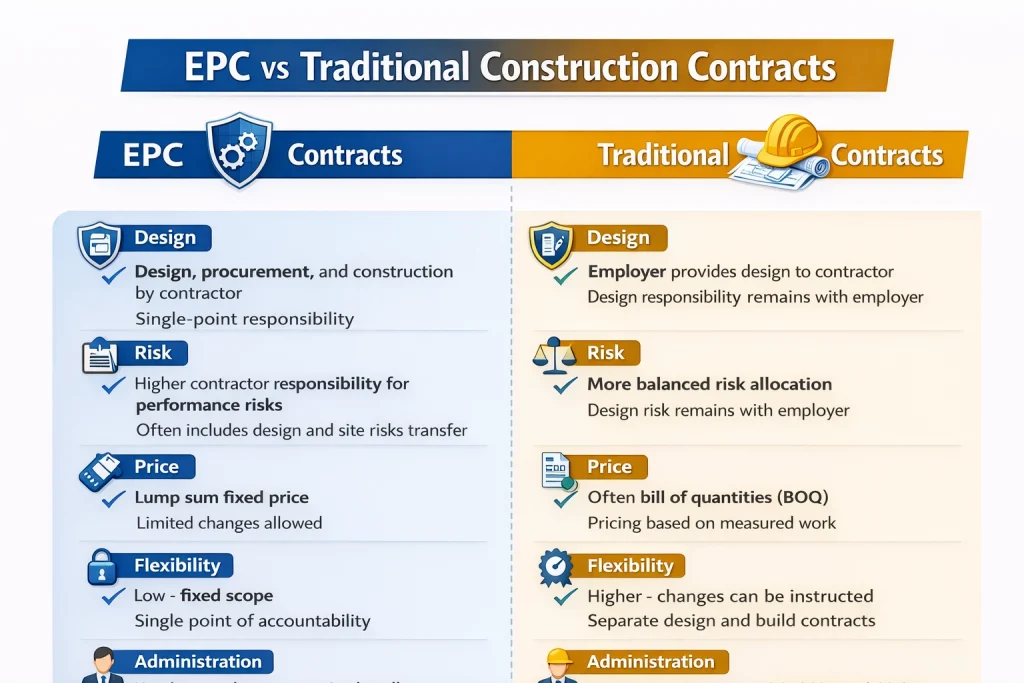
Understanding differences helps you choose and draft appropriately.
| Aspect | EPC Contracts | Traditional Construction |
|---|---|---|
| Design | Contractor designs | Employer designs |
| Risk | Contractor-heavy | More balanced/shared |
| Price | Lump sum fixed | Often Bill of Quantities |
| Flexibility | Low – fixed scope | Higher – can adjust scope |
| Completion basis | Performance guarantees | Build per drawings |
| Administration | Employer’s Rep | Independent Engineer |
| Best for | Turnkey delivery, fixed outcome | Employer controls design |
Choose based on your project needs and risk appetite.
Construction Contract Templates and Examples
Construction contract templates and examples help by providing structure and reminding teams of necessary clauses. They save time on standard provisions and work well as starting points.
Templates fail when copied blindly without project-specific thinking. Every contract needs customization. Different risks, different parties, different requirements mean different clauses. Use templates for structure but think through every provision for your specific project.
Common Drafting Mistakes in Construction Contracts
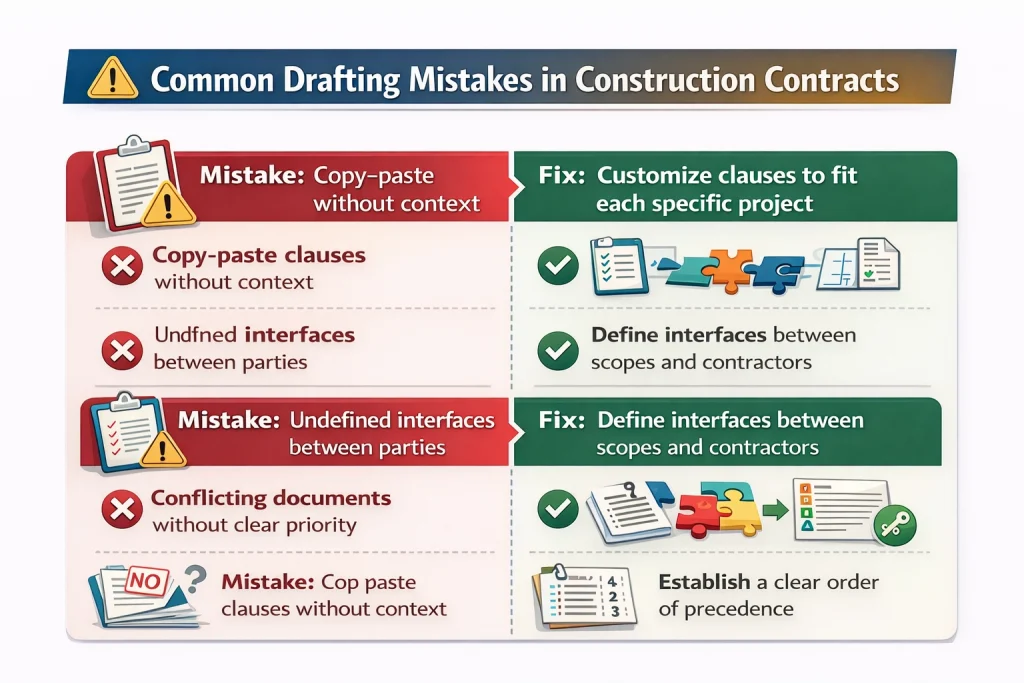
Common drafting mistakes in construction contracts appear repeatedly across projects. Undefined interfaces between contractor scopes create gaps and overlaps that trigger expensive disputes. Missing time bars allow claims to arrive years after events when evidence has disappeared.
Poorly worded liquidated damages clauses that look like penalties get struck down by courts. Vague scope descriptions like “install all necessary equipment” guarantee arguments about what necessary actually means. Conflicting contract documents without a stated priority create interpretation battles.
Always include a priority clause. “In case of conflict: Agreement takes priority, then Special Conditions, then General Conditions, then Specifications, then Drawings.”
Conclusion
Strong contracts prevent disputes. Weak contracts almost guarantee them. The investment in quality construction contract drafting best practices is tiny compared to the cost of disputes, delays, and failed projects.
Draft clearly. Allocate risks fairly. Follow procedures consistently. Manage contracts actively throughout execution. Your projects and your career will both benefit significantly.
Frequently Asked Questions
What is the most important clause in a construction contract?
Scope definition. Clear scope prevents most disputes by ensuring everyone understands exactly what is included, excluded, and required before work begins on site.
How do I protect myself from scope creep in construction contracts?
Define scope precisely with drawings and specifications. List explicit exclusions. Require written variation orders before additional work proceeds. Maintain records comparing original scope to actual work performed.
Can aggressive contract terms reduce project costs?
No. Aggressive terms increase costs because contractors price unreasonable risks into bids. Balanced clear contracts attract better contractors at more competitive prices without expensive contingency allowances.
Should engineers be involved in contract drafting and negotiation?
Absolutely. Engineers identify technical risks lawyers miss, assess timeline feasibility, and explain contractual consequences of technical decisions. Best contracts combine commercial, legal, and technical expertise throughout the drafting process.
When should FIDIC contracts be heavily customized?
Customize heavily when projects have unique risks not covered by standard forms, local law requires specific provisions, or the project delivery method does not match standard FIDIC assumptions and risk allocations.
How can I negotiate fairly without losing commercial advantage?
Focus on fair risk allocation rather than winning every clause. Understand the other side’s concerns. Trade concessions strategically on priority terms while being flexible on less critical contract provisions.
What should I do if the other party refuses to negotiate certain terms?
Understand their underlying concern rather than fighting the clause directly. Offer alternative allocations that achieve their protection goal differently. Quantify the risk and price it separately if truly stuck on a specific provision.
How detailed should construction contract specifications be?
Detailed enough that a competent contractor knows exactly what to build without guessing. Reference international standards. Balance clarity with flexibility to avoid over-specification that unnecessarily limits contractor innovation and efficiency.
Should liquidated damages rates be the same for all projects?
No. LDs must reflect genuine anticipated losses specific to each project including lost revenue, financing costs, and timing losses. Document your calculation basis to demonstrate LDs are genuine pre-estimates and not penalties.
What is the biggest mistake in construction contract negotiation?
Fighting every single clause exhausts both parties and kills deals. Prioritize critical terms, be flexible elsewhere, trade risks strategically, and document every agreement immediately after each negotiation session to prevent backtracking.