

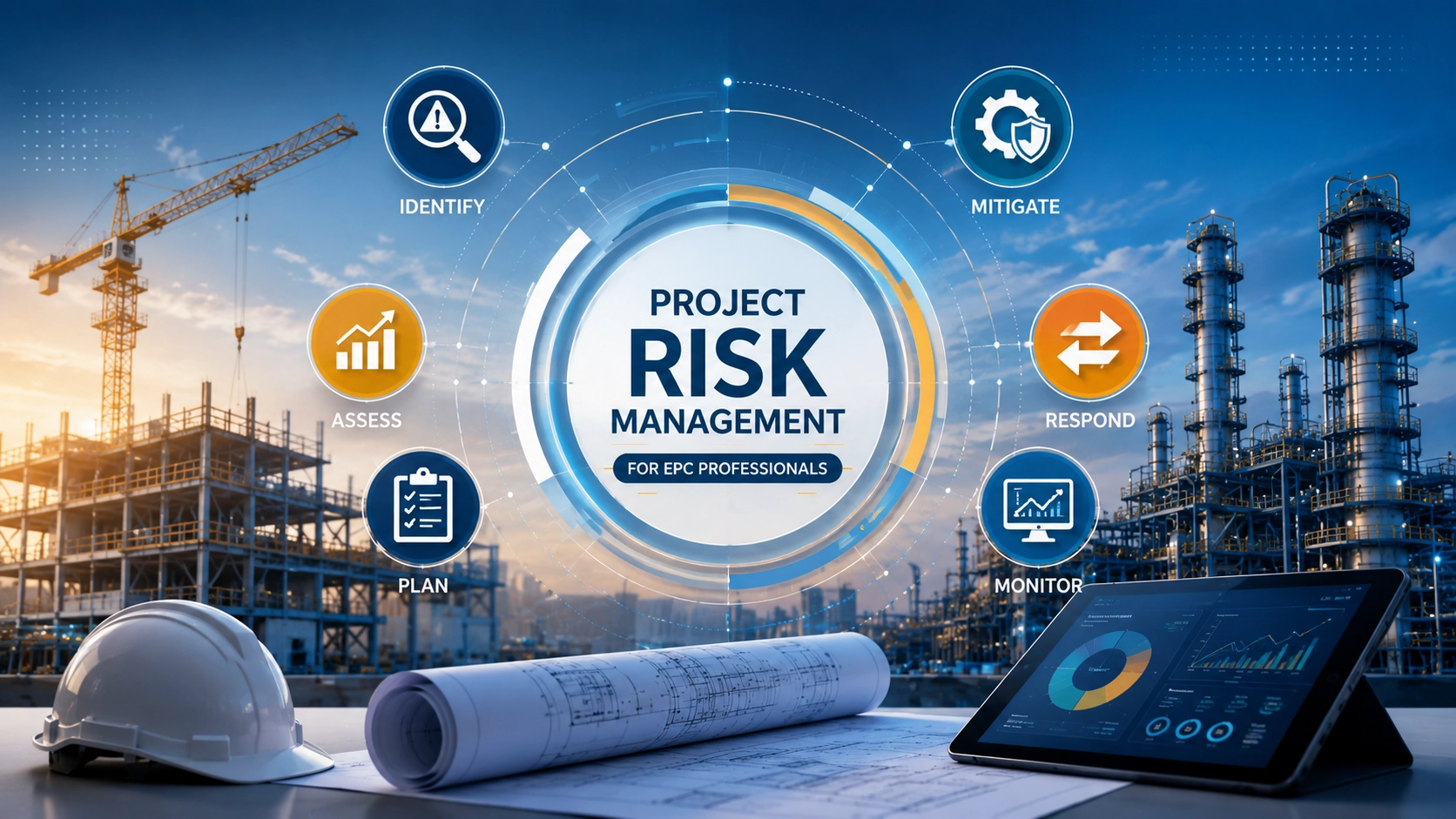
Key Takeaways
- EPC projects fail because of poor risk management, not poor engineering. Teams that spot risks early deliver on time and on budget. Teams that manage risk reactively spend the whole project putting out fires.
- The highest-value risk work happens before construction starts. By the time construction begins, risks are expensive to fix. Most teams get this completely backwards.
- Every risk needs an owner and a plan. Writing a risk in a register is not enough. Someone must be responsible for it, with clear action steps and a deadline.
- Procurement is where most EPC projects quietly fall apart. It makes up 50 to 70 percent of the total project cost. Order long-lead equipment late, and the whole project waits.
- Structured risk management produces real financial results. Trained teams complete 85 percent more projects successfully. They also report up to 23 percent lower project costs compared to teams managing risk by gut feeling.
Every EPC project carries risk. Tight fixed-price contracts, global supply chains, complex multi-discipline engineering, and demanding commissioning timelines all create conditions where a single unforeseen event can cascade into serious cost and schedule consequences.
The difference between projects that succeed and projects that overrun is rarely technical competence. It is almost always the quality of risk management. Teams that identify risks early, plan responses in advance, and monitor threats continuously deliver projects on budget and on time. Teams that manage risk reactively spend the project firefighting.
This guide is written for EPC professionals who want to move from reactive to proactive risk management. It covers the complete process, the key tools, the most important risk categories, and how structured training builds the competence to apply them consistently.
Table of Contents
What is Project Risk Management in EPC?
Project risk management is the systematic process of identifying, analyzing, and responding to uncertain events that could affect project cost, schedule, quality, safety, or performance.
In the EPC context, risk management has a specific character. The EPC contractor operates under a lump-sum, fixed-price contract. The owner transfers the majority of project risk to the contractor at contract award. This means the contractor is financially exposed to a wide range of events, many of which occurred before the project was even won.
Effective EPC project risk management protects project margin, keeps schedules intact, and prevents the four outcomes that define EPC failure: a time disaster, a commercial disaster, a quality disaster, and a health, safety, or environmental incident.
Why Structured Risk Management Matters: The Evidence
Risk management in EPC projects is not a documentation exercise. It delivers measurable financial outcomes.
Research from the Project Management Institute (PMI) shows that organizations with mature risk management practices complete 85% more projects successfully than those without structured approaches. Companies implementing comprehensive risk management frameworks report an average 23% reduction in project costs and 31% improvement in delivery timelines.
A study of 42 EPC professionals across Indian infrastructure projects (IJRASET, 2026) found that formal risk documentation and systematic risk tracking remain underutilized across project phases, particularly in engineering and procurement. Mitigation efforts tend to peak during construction, which is the most expensive phase to intervene. The finding confirms what experienced project managers already know: the highest-value risk management activity happens before construction starts, not during it.
The 6-Step EPC Risk Management Process
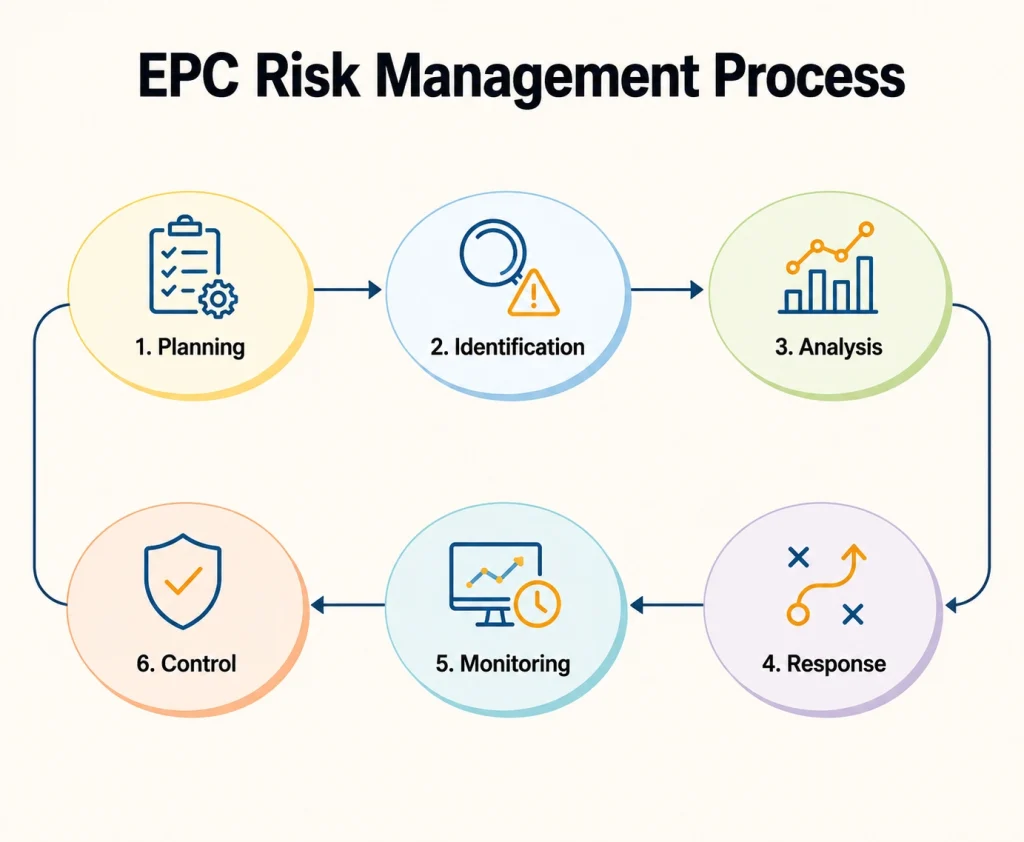
Step 1: Risk Management Planning
Before any risks are identified, establish the framework. A Risk Management Plan defines the methodology, tools, roles, risk thresholds, and reporting frequency for the project. This plan is produced at project kickoff and approved by the Project Director and the owner.
Without a Risk Management Plan, risk activities become ad hoc and inconsistent. Every project team member needs to know what the process is, who owns it, and how risk information feeds into project decisions.
Step 2: Risk Identification
Identify every event or condition that could affect project objectives. Use a structured combination of:
- Brainstorming workshops with cross-discipline teams covering engineering, procurement, construction, commercial, and HSE
- Checklist review drawn from lessons learned on previous similar projects
- SWOT analysis to surface internal and external threats and opportunities
- Contract and site investigation review to identify obligations and ground conditions
- Expert interviews with specialists in areas of technical uncertainty
The output is a Risk Register that lists each risk, its cause, its potential effect on the project, and the phase in which it is most likely to occur.
A common mistake is treating risk identification as a one-time activity. New risks emerge throughout the project lifecycle. The Risk Register must be a live document, not an archived spreadsheet.
Step 3: Qualitative Risk Analysis
Once risks are identified, assess each one using expert judgment. Assign a probability score (how likely is this to occur?) and an impact score (how severely would it affect cost, schedule, quality, or safety?) on a defined scale, typically 1 to 5 or Low to High.
Plot the results on a Risk Matrix (Probability-Impact Matrix):
| Risk Priority | Probability | Impact | Required Action |
|---|---|---|---|
| Critical | High | High | Immediate response plan required |
| Significant | Low | High | Contingency planning required |
| Moderate | High | Low | Monitor and manage actively |
| Low | Low | Low | Accept and log |
The risk matrix produces a priority ranking that focuses team attention on the risks most likely to damage the project. It is the most commonly used risk tool on EPC projects and the foundation for all subsequent analysis.
Step 4: Quantitative Risk Analysis
For high-priority risks and projects with significant financial complexity, move beyond qualitative scoring to numerical methods:
- Monte Carlo Simulation: Runs thousands of scenarios using probability distributions for cost and schedule variables. Produces a probability curve showing the likelihood of achieving the target cost or completion date. Provides the data needed to size contingency reserves accurately.
- Expected Monetary Value (EMV) Analysis: Multiplies the probability of each risk by its financial impact. Prioritizes risks in currency terms and supports contingency budgeting.
- Sensitivity Analysis (Tornado Chart): Identifies which individual risks have the greatest effect on the overall project outcome. Focuses mitigation resources on the risks that matter most.
Quantitative analysis is particularly valuable when presenting risk to senior leadership, project financiers, or regulatory bodies. It replaces subjective descriptions with data-driven probability statements.
Step 5: Risk Response Planning
For each prioritized risk, assign a named owner and develop a specific response. The four standard strategies for negative risks are:
Avoid: Change the plan to eliminate the risk. Decline a contract in a politically unstable region. Select a construction method that avoids a known geotechnical hazard. Change a procurement source to avoid a sanctioned supplier.
Transfer: Shift the financial consequence of the risk to a third party. Purchase construction all-risk (CAR) insurance. Require performance bonds from critical subcontractors. Use fixed-price subcontracts to pass material cost risk downstream.
Mitigate: Reduce the probability or impact to an acceptable level. Conduct thorough FEED before contract award to reduce design risk. Order long-lead equipment during FEED to reduce procurement delay risk. Use BIM and 3D modeling to identify design clashes before construction begins.
Accept: Acknowledge the risk without proactive action. Appropriate for low-probability, low-impact risks. Maintain a contingency reserve to absorb the impact if the risk materialises.
Combined strategies are often most effective. For example, mitigating the probability of a procurement delay through expediting and dual-sourcing, while simultaneously transferring the financial consequence through supplier performance bonds.
Every response plan must include: the risk owner by name, specific action steps, target completion date, and the cost of the response.
Step 6: Risk Monitoring and Control
Risk management does not stop at planning. It runs continuously throughout the project:
- Review and update the Risk Register at every phase gate and milestone
- Monitor risk trigger events, the early warning signals that a risk is about to materialise
- Evaluate whether existing response plans are working
- Identify and assess new risks as they emerge
- Report risk status to project leadership at defined intervals
- At project close, capture all lessons learned and input them into the organizational risk knowledge base for future projects
The Most Critical Risk Categories for EPC Professionals
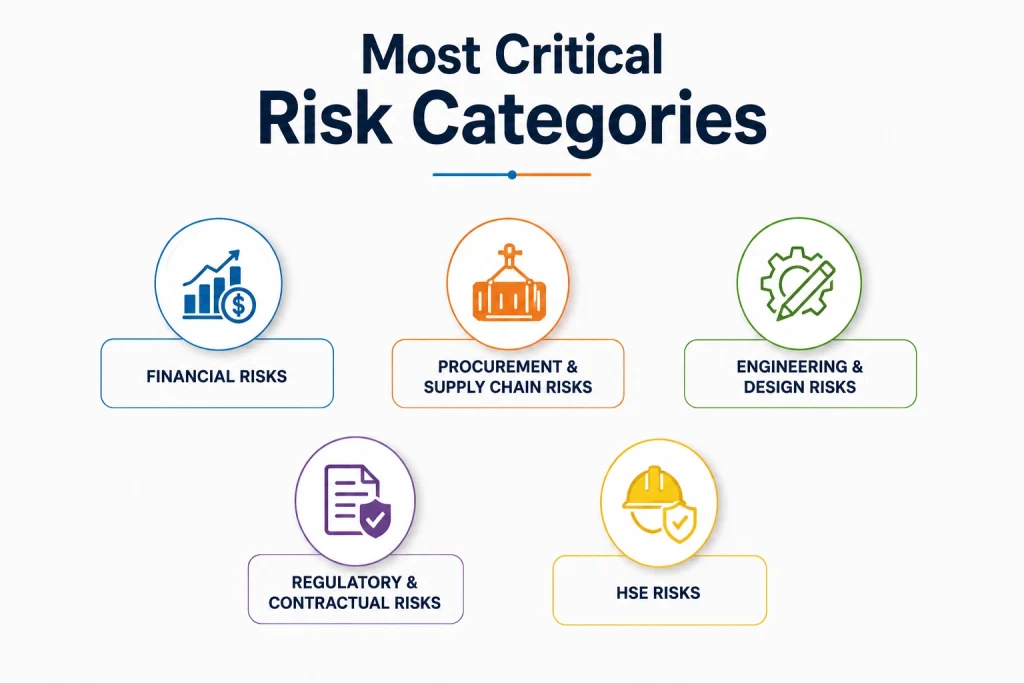
Financial and Commercial Risks
Fixed-price EPC contracts place the contractor at direct financial risk from material price escalation, currency fluctuations, inaccurate bid estimates, and scope growth. Delayed client payments strain cash flow. Every percentage point of cost overrun on a fixed-price contract comes directly off the contractor’s margin.
Procurement and Supply Chain Risks
Procurement represents 50 to 70% of the total EPC project cost. Long-lead equipment, including turbines, pressure vessels, and transformers with lead times of 12 to 24 months, creates significant schedule exposure. Supply chain disruptions from geopolitical events, strikes, or logistics failures compound this risk. The COVID-19 pandemic demonstrated how a global supply chain event can simultaneously delay hundreds of EPC projects worldwide.
Engineering and Design Risks
Design errors discovered during construction are exponentially more expensive to correct than errors found during engineering. A design miscalculation in a load-bearing structure can halt construction entirely until the fix is engineered and re-approved. BIM-based clash detection, constructability reviews, and structured interdisciplinary design checks significantly reduce this risk.
Regulatory and Permitting Risks
Regulatory approval delays rank as the highest-impact risk in Indian EPC projects. Environmental permits, statutory inspections, and local authority approvals all sit outside the contractor’s control but directly affect the project schedule. Early engagement with regulatory bodies and a dedicated permitting manager is non-negotiable on major projects.
Contractual and Legal Risks
Ambiguous scope definitions, poorly structured Liquidated Damages provisions, unclear force majeure clauses, and inadequate change management procedures all create contractual risk. When risk is pushed onto a party that cannot control or price it, the result is disputes, claims, and quality compromises as the distressed party tries to recover losses.
Health, Safety, and Environmental (HSE) Risks
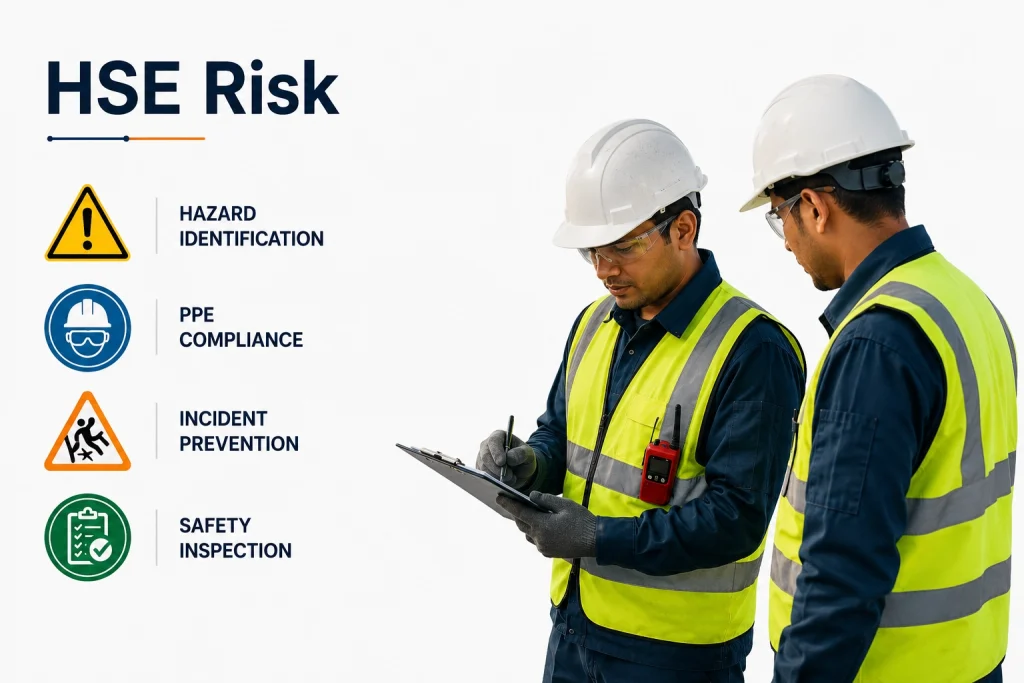
A single serious safety incident can shut down a construction site, trigger a regulatory investigation, and cause reputational damage that affects the contractor’s ability to win future work. HSE risk management is not separate from project risk management. It is central to it.
Key Tools Every EPC Risk Professional Should Know
| Tool | What It Does |
|---|---|
| Risk Register | Central, live record of all identified risks, owners, and responses |
| Probability-Impact Matrix | Visual prioritization of risks by likelihood and severity |
| Monte Carlo Simulation | Probabilistic forecasting of cost and schedule outcomes |
| Bow-Tie Analysis | Maps the causes and consequences of major hazard risk events |
| Earned Value Management (EVM) | Provides early warning of cost and schedule deviations |
| Sensitivity Analysis (Tornado Chart) | Identifies risks with the greatest overall project impact |
| SWOT Analysis | Identifies internal and external threats and opportunities |
Why EPC Professionals Need Formal Risk Management Training
Technical expertise alone does not produce good risk management. An engineer who is brilliant at process design may have no framework for quantifying the schedule risk of a late vendor drawing. A procurement manager with deep sourcing experience may never have built a risk-adjusted supply chain strategy. A site manager who has built ten plants may still manage risk by instinct rather than process.
Formal risk management training closes these gaps. It equips professionals with:
- A structured process that they can apply consistently to every project
- The analytical tools to quantify risk and size contingency accurately
- The language to communicate risk clearly to owners, boards, and financiers
- The contract knowledge to allocate risk appropriately and protect the margin
- The confidence to raise risk issues early, before they become crises
At RKS Trainings, our Risk Management Workshop is built on 25 years of live EPC project experience. It uses real project case studies, risk register exercises, and risk matrix workshops to develop practical skills that participants can apply immediately. The program is designed for project managers, commercial managers, procurement professionals, contract administrators, and site engineers working in EPC and project-driven environments.
Conclusion
Risk is present in every EPC project. The question is never whether risks will occur. It is whether the project team identified them early enough, planned responses in advance, and monitored them closely enough to intervene before they caused serious damage.
The six-step risk management process, supported by the right tools and the right training, gives EPC professionals the framework to answer that question consistently with yes.
If you want to build a structured risk management capability within your team, explore our Risk Management Workshop or contact us at +91 9010420088.
FAQs
What is project risk management in EPC projects, and why is it important?
Project risk management in EPC is the structured process of identifying, analyzing, and responding to threats that could affect cost, schedule, quality, or safety. It protects contractor margin and ensures timely project delivery.
What are the most common risk management tools used in EPC project management?
The most common tools are the risk register, probability-impact matrix, Monte Carlo simulation, bow-tie analysis, earned value management, and sensitivity analysis. Each tool supports a specific step in the risk management process.
How does qualitative risk analysis differ from quantitative risk analysis in EPC projects?
Qualitative risk analysis uses expert judgment and scoring scales to prioritize risks. Quantitative analysis uses numerical methods like Monte Carlo simulation to model probability, financial impact, and contingency requirements with greater precision.
What are the four risk response strategies used in EPC project risk management?
The four strategies are avoid (eliminate the risk), transfer (shift it to a third party), mitigate (reduce probability or impact), and accept (acknowledge without action). Most EPC professionals use a combination of strategies on a single risk.
How do procurement risks affect the overall schedule of an EPC project?
Procurement risks, especially delays in long-lead equipment like turbines and transformers, directly delay construction and commissioning. A single late item on the critical path can cascade into weeks or months of project schedule overrun.
What should be included in an EPC project risk register for effective risk tracking?
An EPC risk register should include the risk description, cause, impact on cost and schedule, probability score, impact score, risk owner, response strategy, action steps, and current status updated at each project milestone.
How does risk management training help EPC professionals reduce project cost overruns?
Risk management training gives EPC professionals the tools to identify risks early, size contingency accurately, and implement mitigation before costs escalate. Trained teams report up to 23% lower project costs compared to untrained counterparts.
What is the role of a risk matrix in EPC project risk assessment and planning?
A risk matrix plots each identified risk by probability and impact, producing a visual priority ranking. It focuses team attention on critical risks that need immediate response plans and separates them from lower-priority items to monitor.
How should EPC contractors manage contractual risks related to liquidated damages and scope changes?
EPC contractors should clearly define the scope before contract award, negotiate fair LD caps, include robust change management provisions, maintain contemporaneous records, and assign a dedicated contract administrator to track variations from day one.
What is a Monte Carlo simulation, and how is it used in EPC project risk quantification?
Monte Carlo simulation runs thousands of scenarios using probability distributions for cost and schedule inputs. It shows the likelihood of achieving target outcomes and gives project managers data to size contingency reserves accurately and defend them to stakeholders.