
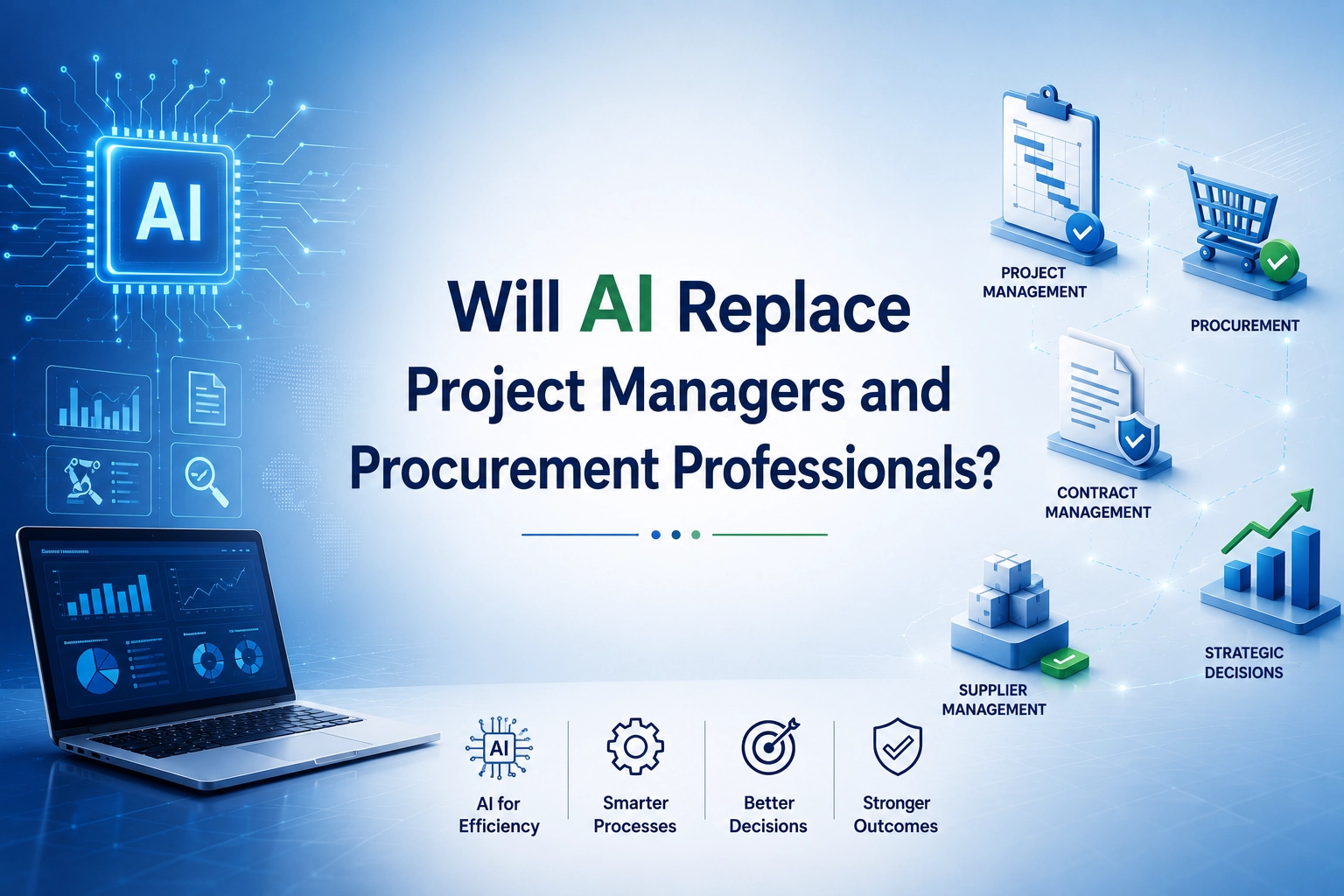
Quick answer: No, AI will not fully replace project managers or procurement professionals, but it will absorb specific tasks within those roles. AI handles data analysis, reporting, document review, scheduling support and routine procurement work. Judgement, negotiation, stakeholder management, risk decisions and accountability stay human. The real shift is simple: professionals who learn to use AI will replace those who do not.
The worry is understandable. AI now drafts documents, crunches spreadsheets and answers complex questions in seconds. Tools that felt like science fiction a few years ago are now part of everyday work. Therefore, it is fair to ask whether a career in project management or procurement still has a future, or whether the software is taking over the job.
The honest answer is more reassuring than fear, and also more demanding. AI is not going to make these professionals obsolete. But it is going to change what they do, and it will reward the ones who adapt while leaving behind the ones who do not.
Key takeaways
- AI replaces tasks within roles, not project management or procurement careers themselves.
- It excels at data analysis, reporting, document review and routine work.
- Judgement, negotiation, accountability and stakeholder management stay firmly human.
- AI can be confidently wrong and lacks accountability, so it needs skilled human oversight.
- The genuine risk is refusing to learn AI, not AI itself.
- The winners combine strong fundamentals with real AI fluency.
What will AI replace, and what will it not?
AI replaces tasks, not whole roles. That single distinction is the key to the entire question.
- What AI is great at: processing data, summarising long documents, generating first drafts, spotting patterns, and answering questions fast
- What AI cannot do: own an outcome, build genuine trust, negotiate under pressure, read a room, or take the blame when a project goes sideways
Those human responsibilities are the actual core of project and procurement leadership, and they are not going anywhere. A project manager is ultimately accountable for delivery. A procurement professional is responsible for the relationships and judgment behind every major decision. No algorithm carries that weight.
The real question to ask
Instead of asking whether AI will take your job, the smarter question is which parts of your job AI can take off your plate, and what that frees you up to do. The professionals who ask the second question are the ones who thrive.
What is AI already doing in project management?
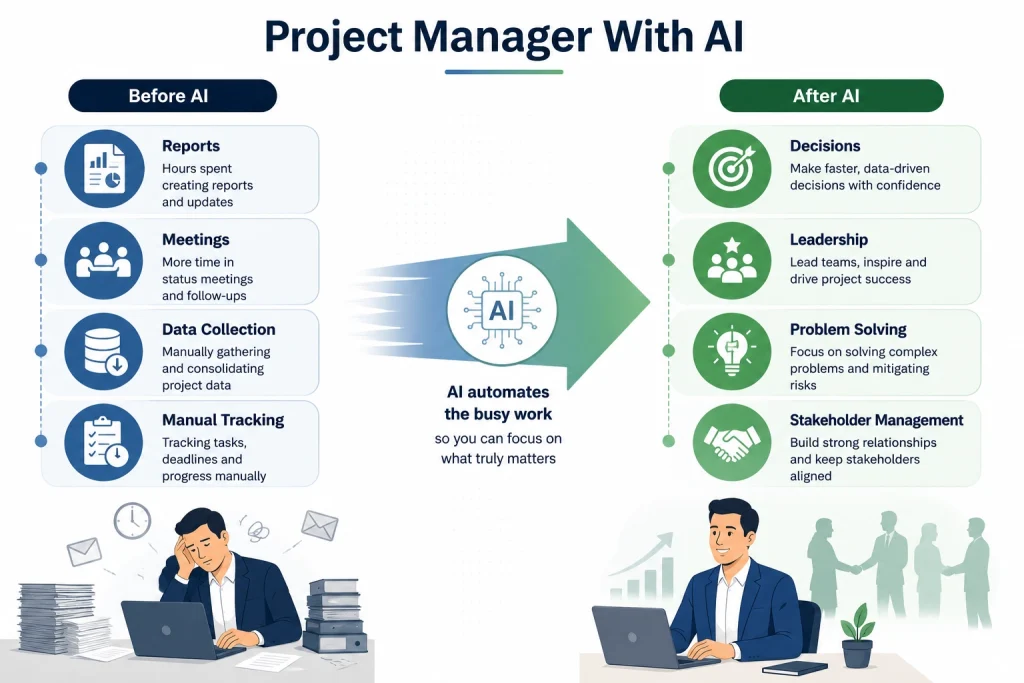
Quite a lot, and most of it is genuinely useful. On real projects, AI can already:
- Analyze schedules and flag tasks that are likely to slip
- Summarise long status reports and meeting notes in seconds
- Draft routine communications, updates and reports
- Predict risks by learning from historical project data
- Answer questions about complex project documents instantly
- Help with cost forecasting and resource planning
The effect is not that managers vanish. It is that they get freed from grunt work to focus on decisions, people and problem-solving. The manager who uses AI well simply delivers faster, with better information in front of them, and spends more time on the things that actually need a human.
A practical example
Imagine a project manager who once spent hours every week pulling data into a status report. With AI handling the first draft, that same manager now spends those hours walking the site, resolving a supplier dispute and coaching a junior engineer. The work that matters most gets more attention, not less.
What is AI doing in procurement and contracts?
The tasks AI is already speeding up
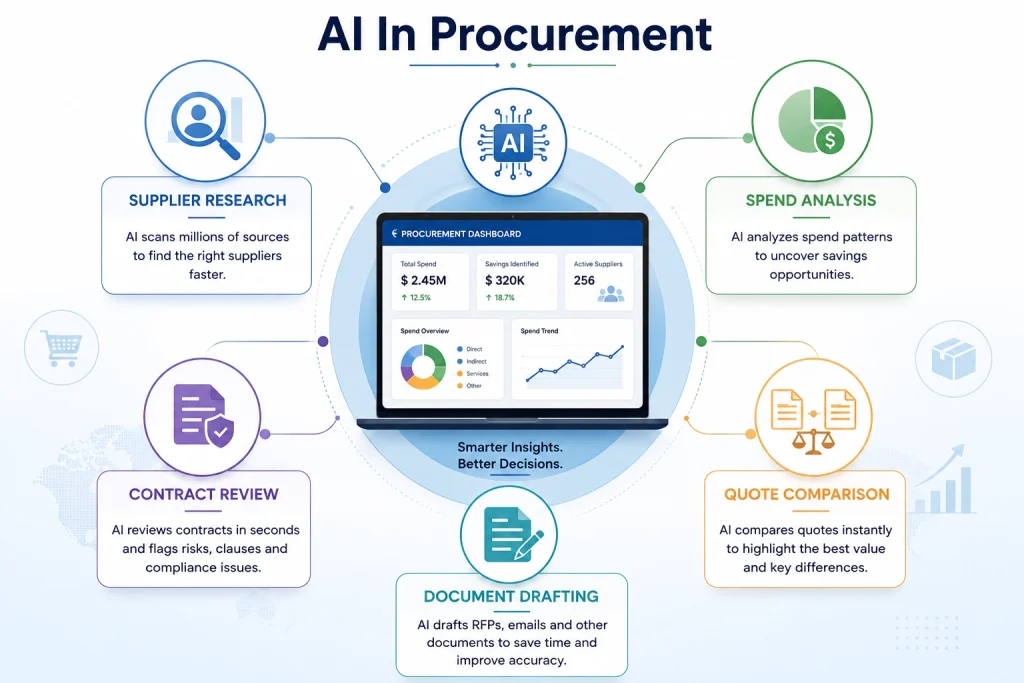
In procurement, AI speeds up the slow, document-heavy parts of the job:
- Supplier research and shortlisting
- Spend analysis across large and messy datasets
- Scanning contracts for risky or unusual clauses
- Comparing quotes and surfacing insights from purchasing data
- Drafting routine procurement documents and correspondence
Tools like ChatGPT let procurement and contract teams draft, review and analyse far faster than before. A task that once took days of manual reading can now be accelerated significantly.
Where the human still decides
But the decisions that carry weight still sit with people. AI can flag a risky clause, but a professional decides how to handle it. AI can compare suppliers, but a professional decides which one to trust, how to negotiate, and how to allocate risk. The data is faster, but the judgment, relationships and accountability behind the decisions remain firmly human.
What are the limits and risks of relying on AI?
It is important to be clear-eyed about what AI cannot be trusted to do on its own. Relying on it blindly creates real risks:
- It can be confidently wrong. AI can produce answers that sound right but are not, so its output must always be checked.
- It lacks accountability. When something goes wrong, a person, not a tool, has to answer for it.
- It does not understand context fully. AI misses the unwritten relationships, politics and history that shape real decisions.
- It raises data and confidentiality concerns. Sensitive contract and project information has to be handled carefully.
This is exactly why AI works best as a powerful assistant guided by a skilled professional, not as a replacement for one.
Which skills make you AI-proof?
The human skills AI cannot copy
The smart move is to build the skills AI cannot copy:
- Sound judgement under uncertainty
- Negotiation and persuasion
- Stakeholder and relationship management
- Risk decision making
- Ethical accountability
- The ability to lead people through difficult situations
These are the skills that define senior, well-paid roles, and they become more valuable, not less, as routine work gets automated.
The one new skill worth adding
Add one more to that list: the skill of working effectively with AI tools. Knowing how to prompt, guide, check and apply AI output is quickly becoming a core professional capability. Combine human judgement with AI fluency, and your value rises rather than falls.
The professionals genuinely at risk are not the ones whose tasks AI can do. They are the ones who refuse to learn AI, while the tools quietly advance around them, and their colleagues pull ahead.
Which roles are most and least exposed to AI?
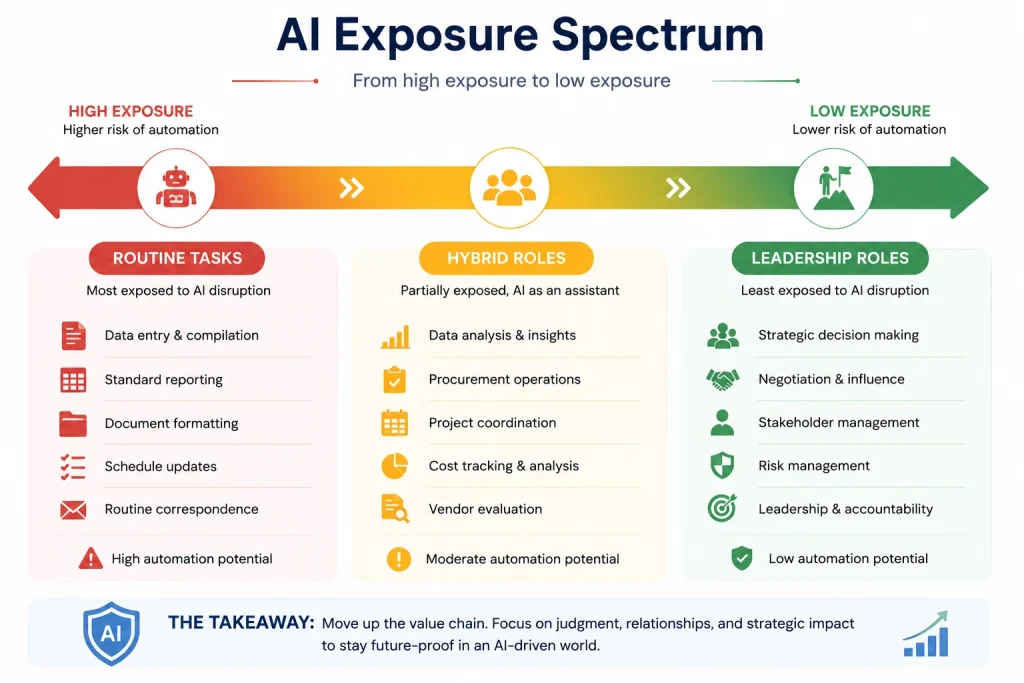
Not every role faces the same level of change. It helps to think about exposure on a spectrum.
Most exposed
- Heavily routine, data entry and documentation-focused roles
- Work that is repetitive and rules-based with little judgment involved
- Roles centred on producing standard reports rather than making decisions
Least exposed
- Senior project and programme management roles
- Negotiation-heavy procurement and contracts positions
- Leadership roles built on relationships, trust and accountability
The clear lesson is to move up the value chain. The more your work depends on judgment, leadership and relationships, the safer and more valuable it becomes in an AI-driven world.
How to upskill for the AI era
Fear is the wrong response to AI. Capability is the right one. The goal is to become the kind of professional who uses AI to multiply their impact, while bringing the human judgment that AI lacks.
That means building on two fronts at once:
- Strong fundamentals in project management, procurement, contracts and risk
- Practical AI fluency in tools that support those disciplines
Learn to use AI inside strong fundamentals, and you become far more productive than either a person without AI or AI without a person. That combination is where the future of these careers lies.
Where RKS Trainings fits in
This blend is exactly what RKS Trainings focuses on. Its practitioner-led courses cover AI skills for procurement and using ChatGPT for procurement and contract management, sitting alongside core EPC project management, contracts and risk training.
The pairing is deliberate. AI tools are most powerful in the hands of someone who already understands projects and procurement deeply, because they know what good output looks like and where the tool is likely to go wrong. RKS Trainings builds both the timeless fundamentals and the modern AI capability, which is what keeps a career ahead of the curve rather than scrambling to catch up. For engineers and procurement professionals who want to future-proof their careers, that combination is the smart investment.
FAQs
Will AI replace project managers?
No, AI will not replace project managers, but it will automate tasks like reporting, scheduling support and data analysis. Judgement, negotiation, stakeholder management and accountability stay human, so the role becomes more strategic rather than disappearing.
Will AI replace procurement jobs?
AI will automate routine procurement tasks such as spend analysis, supplier research and contract review, but it will not replace the judgment, negotiation and relationships that define procurement. Skilled professionals who use AI become more valuable.
What can AI do in project management?
AI can analyze schedules, flag likely delays, summarize reports, draft communications and predict risks from historical data. This frees project managers to focus on decisions, people and problem-solving rather than routine analysis and paperwork.
How does AI help in procurement?
AI speeds up supplier research, spend analysis, contract clause review and documentation. It surfaces insights from purchasing data quickly, helping procurement teams work faster while professionals make the decisions on suppliers, negotiation and risk.
Is project management a safe career from AI?
Yes, project management is relatively safe because its core involves judgment, leadership and accountability that AI cannot provide. Professionals who learn to use AI tools strengthen their position rather than face replacement.
What are the risks of using AI in projects?
AI can be confidently wrong, lacks accountability, misses context and raises data confidentiality concerns. Its output must always be checked by a skilled professional, which is why AI works best as an assistant, not a replacement.
What skills make professionals AI-proof?
Judgement, negotiation, stakeholder management, risk decision making, ethical accountability and leading through uncertainty cannot be automated. Adding the skill of working effectively with AI tools further raises your professional value.
Can ChatGPT be used for contract management?
Yes, ChatGPT can help draft, review and summarise contracts and flag risky clauses, speeding up routine work. However, final decisions on risk allocation, negotiation and acceptance must remain with skilled contract professionals.
Should I learn AI skills as an engineer?
Yes, learning AI tools makes you more productive and valuable. AI works best in the hands of professionals who understand projects and procurement deeply, so combining strong fundamentals with AI skills future-proofs your career.
Where can I learn AI skills for procurement and projects?
RKS Trainings offers practitioner-led courses in AI skills for procurement, ChatGPT for contract management, plus core EPC, contracts and risk training, helping professionals combine modern AI capability with timeless project fundamentals.