

Table of Contents
Key Takeaways
- FIDIC contracts training is essential for anyone working on international construction, EPC, or infrastructure projects worth billions of dollars.
- FIDIC Red, Yellow, Silver, and Gold Book training covers four distinct contract types, each with different risk allocation and project delivery approaches.
- What is the purpose of FIDIC contracts? They provide standard forms of contract that FIDIC professionals can use without drafting from scratch each time.
- Red Book vs Yellow Book vs Silver Book differences come down to who designs, who bears risk, and how payment is structured.
- FIDIC Silver Book EPC contract training is critical because contractors take maximum risk, including design, performance, cost, and schedule.
- FIDIC 2017 vs 1999 differences include stricter time bars, stronger early warning duties, and explicit health and safety obligations.
- Missing a 28-day notice deadline under FIDIC claims procedures can permanently time-bar a valid and otherwise winnable claim.
- FIDIC contract management training for engineers shows how technical decisions directly trigger contractual obligations and financial consequences.
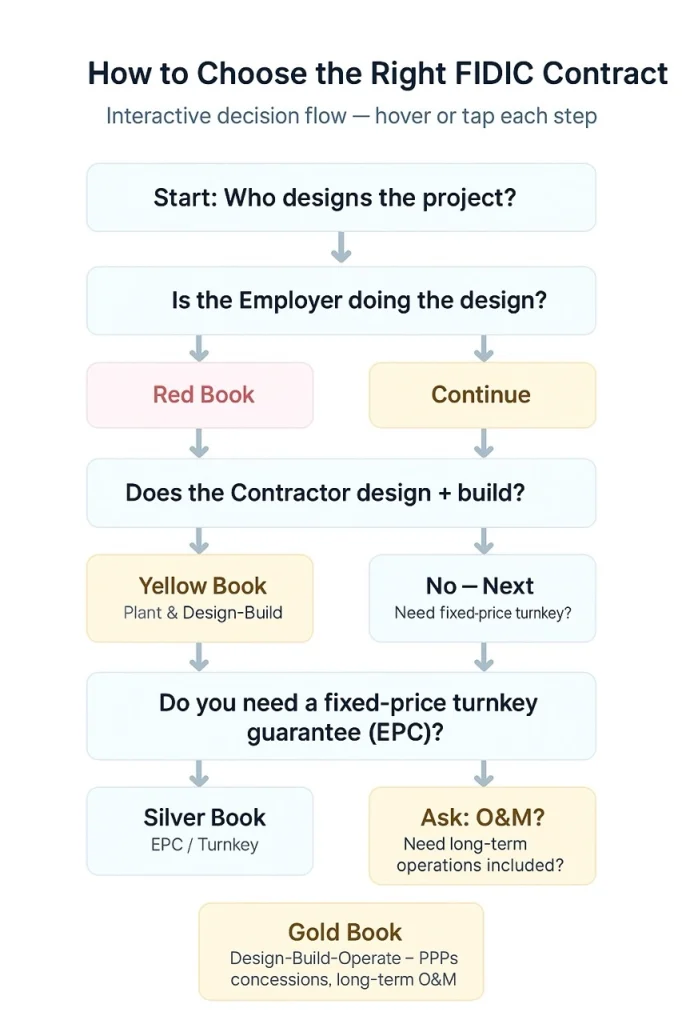
- Which FIDIC contract should I use for EPC? The Silver Book is designed specifically for complete turnkey EPC project delivery.
- FIDIC claims and dispute resolution training teaches teams to prepare, defend, and resolve claims before they reach expensive arbitration.
You are sitting in a contract negotiation for a $500 million power plant project. The client wants to use the FIDIC Silver Book. Your boss leans over and whispers, “Is that the right one for this?” You freeze.
If you do not know the answer, you are about to commit your company to the wrong risk allocation. Possibly millions in unexpected liability.This is exactly why FIDIC contracts training has become non-negotiable for construction and EPC professionals worldwide.
Overview of FIDIC Standard Contract Books: What They Are and Why They Exist
FIDIC stands for the International Federation of Consulting Engineers. They created standard forms of contract that FIDIC professionals can rely on globally. No need to draft contracts from scratch every time. Pick the right template, customize where needed, and start building.
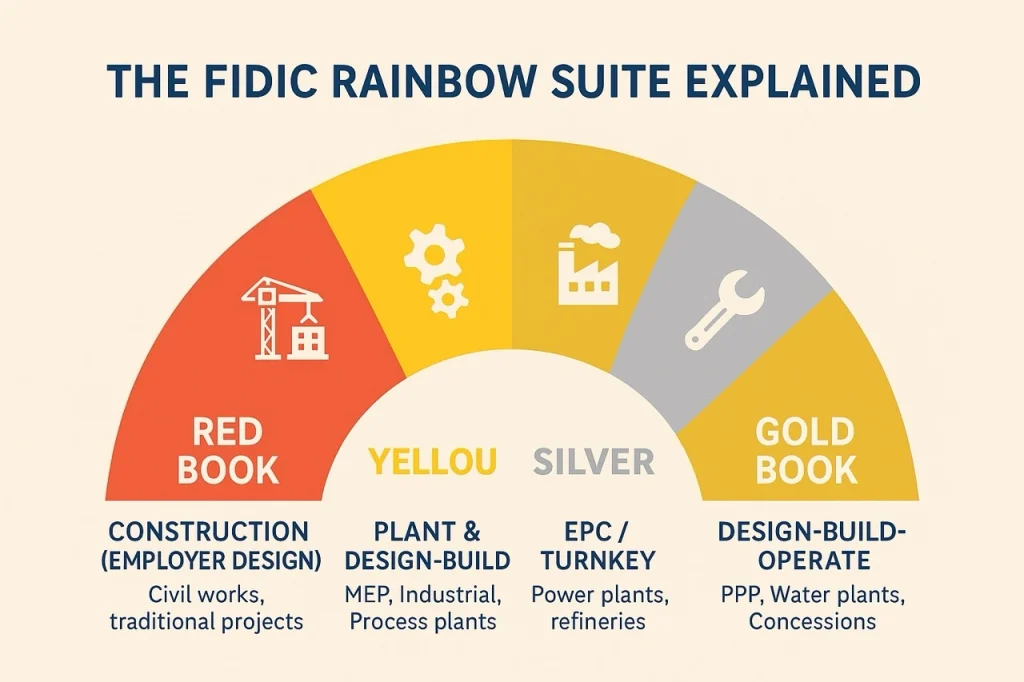
The first FIDIC contract was the Red Book in 1957. Over the decades, FIDIC created a Rainbow Suite because one size does not fit all projects. The four books you will encounter most are the Red Book, Yellow Book, Silver Book, and Gold Book.
What is the purpose of FIDIC contracts?
They ensure consistent risk allocation, transparent administration, and fair commercial terms on construction and engineering projects worldwide. International funding agencies like the World Bank often require them. Many governments mandate them. The question is not whether you will use FIDIC. It is whether you will use it correctly.
Understanding Each FIDIC Book: Red, Yellow, Silver & Gold
Let’s break down each book. What it’s for. When to use it. Who bears what risk?
FIDIC Red Book: Employer-Designed Construction Works
It is designed for traditional construction projects where the employer designs and the contractor builds. Think bridges, roads, dams, and buildings where the employer controls every design detail.
FIDIC Red Book training focuses on measurement-based payment through a Bill of Quantities. Quantities are remeasured during construction, and payment follows actual work done. Risk allocation is relatively balanced. The employer takes design risk. The contractor takes the construction risk.
Ground conditions are particularly important under the Red Book. The employer bears unforeseeable ground condition risks because it controlled the site investigation. If actual conditions differ materially from the geotechnical data, the contractor can claim extra cost and time.
An independent Engineer appointed by the employer but with duties to both parties certifies payments, makes determinations, and approves variations.
Yellow Book: Plant and Design-Build Contracts
FIDIC Yellow Book training covers design-build projects where the contractor both designs and builds the facility. This suits mechanical and electrical works, water treatment plants, and industrial facilities where contractor design expertise adds genuine value.
Design risk shifts dramatically to the contractor. If the design does not work, the contractor fixes it at their own cost. Payment is usually a lump sum or milestone-based.
The independent Engineer remains similar to the Red Book, providing balance between the parties. The Yellow Book works well when you want design innovation and single-point responsibility.
Silver Book: EPC and Turnkey Projects
It is designed for complete turnkey EPC projects where the contractor takes almost all project risk. Think power plants, refineries, and major industrial facilities.
FIDIC Silver Book EPC contract training covers a heavily contractor-loaded risk profile. The contractor takes design risk, construction risk, cost risk through lump-sum pricing, schedule risk, performance risk, and often even ground condition risk.
There is no independent Engineer under the Silver Book. Instead, an Employer’s Representative works directly for and represents the employer without impartiality obligations.
The Silver Book suits projects with well-defined scope, clear site conditions, stable requirements, and experienced contractors who can accurately price all risks. It becomes dangerous when the scope is uncertain or the employer changes requirements frequently.
Gold Book: Design-Build-Operate Contracts
FIDIC Gold Book training covers the least common but important book for public-private partnerships, where the contractor designs, builds, and then operates the facility for years.
Think toll roads operated for 25 years or water treatment plants with long-term operational contracts. The contractor’s incentive aligns with building quality because poor construction means expensive operations later.
Most professionals do not encounter Gold Book projects regularly. But if you work in infrastructure PPPs, this knowledge is essential.
Who Bears Which Risk? — FIDIC Risk Allocation Matrix
| FIDIC Book | Design Risk | Cost Overrun Risk | Ground Condition Risk | Schedule Risk | Performance Risk |
|---|---|---|---|---|---|
|
🏗️
Red Book
Construction (Employer Design)
|
Employer ✗ | Shared 🔄 | Employer ✗ | Shared 🔄 | Shared 🔄 |
|
⚙️
Yellow Book
Plant & Design-Build
|
Contractor ✓ | Contractor ✓ | Shared 🔄 | Contractor ✓ | Contractor ✓ |
|
🏭
Silver Book
EPC / Turnkey
|
Contractor ✓ | Contractor ✓ | Contractor ✓ | Contractor ✓ | Contractor ✓ |
|
🔧
Gold Book
Design-Build-Operate
|
Contractor ✓ | Contractor ✓ | Shared 🔄 | Contractor ✓ | Contractor ✓ |
2017 vs 1999 Editions: What Changed and Why Training Matters
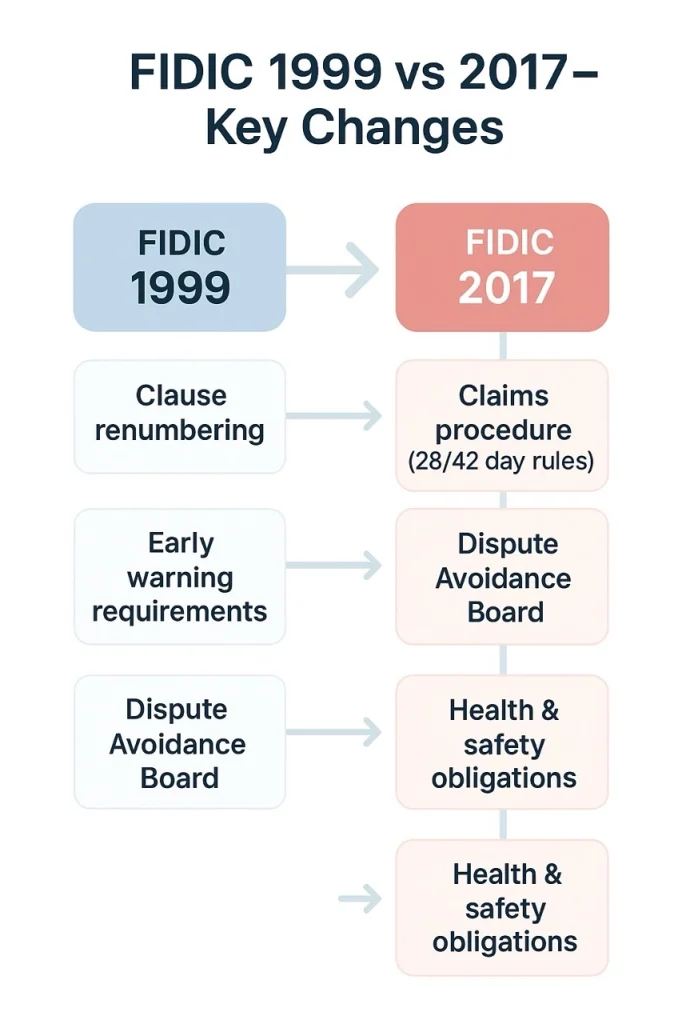
How FIDIC 2017 differs from 1999 is one of the most critical topics in modern FIDIC contracts training. Many professionals learned on 1999 editions. Then in 2017, FIDIC released substantial updates, not minor tweaks.
Key FIDIC 2017 vs 1999 differences include explicit health and safety obligations now placed on both parties, clearer liability cap structures that were often unlimited under 1999 editions, tightened time bars where missing a deadline risks losing your claim entirely, strengthened early warning procedures where failure to warn early can reduce your entitlement, restructured dispute resolution with clearer escalation steps before arbitration, and cleaned-up variation procedures with defined timelines and response requirements.
Professionals applying 1999 knowledge to 2017 contracts make dangerous procedural mistakes. Clause numbers changed. Obligations changed. Your experience from the previous edition can work against you if you do not know what has moved.
Many projects still run on 1999 editions, so you genuinely need to know both versions and understand which your contract uses.
What a Good FIDIC Contracts Training Course Should Cover
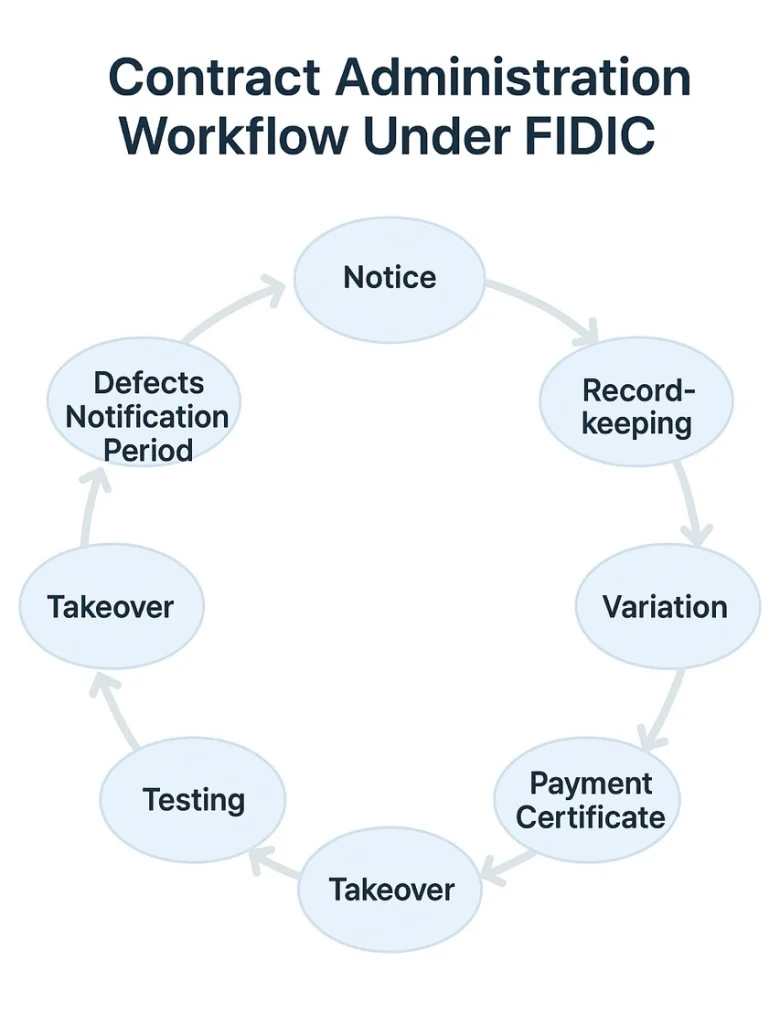
Comprehensive FIDIC Red, Yellow, Silver, and Gold Book training is not about memorizing clauses. It is about understanding how contracts work and how to avoid costly traps.
A quality FIDIC contract administration course should include an introduction to FIDIC and its purpose, explaining why standard forms exist and which projects use them. It needs an overview of all four books, covering when to use each and how risk allocation differs. How to interpret FIDIC clauses through clause-by-clause walkthroughs of major provisions is essential for practical application.
FIDIC claims and dispute resolution training must cover notice requirements, time bars, supporting documentation, extension of time procedures, and how Dispute Avoidance and Adjudication Boards work before escalating to arbitration.
FIDIC claims procedures explained properly should include the full sequence from initial notice through detailed particulars submission, Engineer or Employer Representative determination, DAAB referral, and final arbitration if needed.
Comparison of the 1999 and 2017 editions side by side should show exactly what changed and why it matters for contracts currently in use on live projects.
Real-world case studies using actual project disputes with changed names teach application in ways pure theory cannot. Mock exercises, including drafting variation orders, preparing claims, and responding to notices, reveal gaps in understanding and build genuine confidence.
FIDIC training for EPC and construction professionals should also introduce contract management software, document control systems, and audit trail maintenance because technology increasingly supports good contract administration.
Which Engineer Should Take FIDIC Contract Management Training
FIDIC contract management training for engineers is not just for lawyers or commercial teams. Anyone touching these contracts needs a proper understanding.
Project managers run projects under FIDIC contracts and need to understand obligations, procedures, and risk allocation to make daily decisions confidently. Contract administrators process claims, manage variations, and track compliance, and need deep clause-level knowledge.
FIDIC beginner’s contract training benefits fresh graduates enormously. Starting with solid FIDIC foundations accelerates career development and prevents expensive early mistakes that damage project outcomes and professional reputations.
Engineers and technical staff often believe contracts are someone else’s problem. Wrong. Design changes, quality issues, and testing failures all trigger contract clauses with financial consequences. Site engineers who understand FIDIC become significantly more valuable to their organizations.
Commercial and procurement teams negotiating contracts need to understand what every clause means for their company’s risk exposure. Legal teams with general contract knowledge often struggle with construction specifics, and FIDIC training bridges that critical gap.
Common Pitfalls and Challenges Without Proper Training
Choosing the wrong book is surprisingly common. Using the Silver Book on projects with uncertain ground conditions forces contractors to price huge contingencies, making projects far more expensive than necessary.
FIDIC clauses explained properly prevent the most damaging mistake: missing time bars. Under the 2017 editions, you must give notice within 28 days and submit detailed particulars within 42 days. Miss either deadline, and a valid claim is rejected on procedural grounds regardless of its merits.
Poor variation management through verbal instructions and informal email agreements creates massive payment disputes. The FIDIC variation procedure exists for good reason. Following it every time prevents arguments that consume months of management attention.
Ignoring enhanced early warning obligations under the 2017 editions reduces entitlement to time and money. Many professionals avoid raising problems early because they do not want to admit issues. By the time they notify the other party, it is procedurally too late.
How to Choose the Right FIDIC Training Course
FIDIC Red, Yellow, Silver, and Gold Book training quality varies significantly. Here is what to look for.
Comprehensive coverage of all four books is non-negotiable. Focus on the 2017 editions with proper comparison to 1999 is essential since both are in active use on live projects. Clause-by-clause analysis of major provisions with practical explanation of real-world application separates good training from generic overviews.
FIDIC claims and dispute resolution training should receive serious course time because this is where money is won or lost. Experienced instructors who have actually administered FIDIC contracts, handled real claims, and sat through arbitrations bring insight that purely academic trainers cannot replicate.
Practical resources, including templates, checklists, and procedural flowcharts, give professionals tools they can immediately apply back at work. Certification adds professional credibility and signals to employers that rigorous training has been completed.
Conclusion
FIDIC contracts training is not optional for professionals working on international construction and EPC projects. The wrong book choice, a missed notice deadline, or a misunderstood clause can cost millions.
FIDIC training for EPC and construction professionals provides the foundation for proper contract selection, risk management, claims handling, variation control, and dispute avoidance. The investment in quality training pays back many times over on the very first project where it is properly applied.
Why RKS Trainings is the Preferred Choice for FIDIC Contract Training in Noida & Delhi NCR
For professionals across Noida, Delhi, and the wider NCR region, RKS Trainings has become a trusted destination for mastering FIDIC contracts. With a strong reputation for delivering industry-oriented, practical training, RKS offers specialised programs on the Red, Yellow, Silver, and Gold Books—designed to meet the needs of engineers, project managers, contract administrators, and EPC professionals.
Their sessions blend real project case studies, hands-on exercises, and clause-by-clause interpretation to ensure participants gain genuine working expertise. Conveniently located in Noida, with additional sessions conducted in Delhi, RKS Trainings provides both classroom and live-online formats, making it accessible for corporate teams and individuals alike. For anyone serious about working on international projects or upgrading contract management capabilities, RKS Trainings stands out as the most reliable and practical choice in the region.
To Learn about Contract Management Training for EPC & Construction Projects – Click Here
Frequently Asked Questions
What is the difference between FIDIC Red, Yellow, and Silver Books?
Red Book suits employer-designed construction. The Yellow Book covers contractor design-build projects. Silver Book handles complete EPC turnkey delivery with maximum contractor risk, fixed price, and guaranteed performance requirements.
Why was the 2017 FIDIC edition released, and what changed?
FIDIC updated contracts to address ambiguities from the 1999 editions. Major changes include explicit health and safety duties, clearer liability caps, tighter time bars, stronger early warning obligations, and restructured dispute resolution procedures.
Can engineers familiar with the 1999 editions transition to 2017 without training?
Technically possible but risky. Clause numbers changed, new obligations were added, and procedures were modified. Professionals applying outdated knowledge make procedural mistakes that lead to missed deadlines and lost claims.
What is the FIDIC Gold Book used for?
Gold Book covers design-build-operate projects where contractors build and then operate facilities long-term. It suits public-private partnerships, toll roads, and water treatment plants with operational contracts spanning decades.
Does the FIDIC Silver Book place too much risk on contractors?
The Silver Book heavily favors employers. It works well when the scope is clearly defined, site conditions are known, and experienced contractors can accurately price all risks. Avoid it for uncertain or frequently changing projects.
What happens if you choose the wrong FIDIC book?
Mismatched risk allocation creates constant friction, inflated contingencies, and ongoing disputes. Wrong book selection increases project costs, delays delivery, and can make projects commercially unviable for one party.
Do engineers need a legal background to understand FIDIC contracts?
No. FIDIC is fundamentally about project delivery and risk management. Many excellent contract managers come from engineering backgrounds. Proper training through a FIDIC contract administration course is what matters most.
How do FIDIC claims and dispute resolution procedures work?
Claims require notice within 28 days and detailed particulars within 42 days. The Engineer or Employer Representative makes determinations. Unresolved disputes go to a DAAB, then arbitration, following defined procedural steps.
What are the most common pitfalls for FIDIC beginners?
Missing notice deadlines, choosing the wrong book, poor variation documentation, ignoring early warning obligations, confusing 1999 and 2017 edition procedures, and inadequate contemporary record-keeping cause most preventable FIDIC disputes.
Can FIDIC training help with complex EPC and international projects?
Absolutely. Proper FIDIC contracts training provides the foundations for contract selection, risk management, claims handling, and dispute avoidance. Many successful international mega-projects credit strong contract management as critical to their delivery success.