

Half of everything your procurement team does today could be automated within three years. That is not speculation. That is the trajectory AI is already on, and most organizations are not ready for it.
The real question is not whether AI will change procurement jobs. It will. The question is whether your team will be positioned to lead that change or be left behind by it. This article gives procurement leaders a clear picture of what is coming, which roles are most affected, and exactly what to do about it.
Table of Contents
The Current State: A Widening Skills Gap
Before looking ahead, it helps to understand where most organizations stand right now.
Only 28% of procurement teams have the AI-ready skills needed to work effectively alongside intelligent tools. Meanwhile, workloads are growing and budgets are not. That combination creates a compounding efficiency gap that does not fix itself.
At the same time, 74% of organizations lack AI-ready data infrastructure. Procurement teams cannot benefit from AI-driven supplier analytics or predictive sourcing if their data sits in disconnected silos across ERP systems, spreadsheets, and legacy platforms.
This is the starting point. The gap is real, it is measurable, and it is growing.
What AI is Actually Automating in Procurement
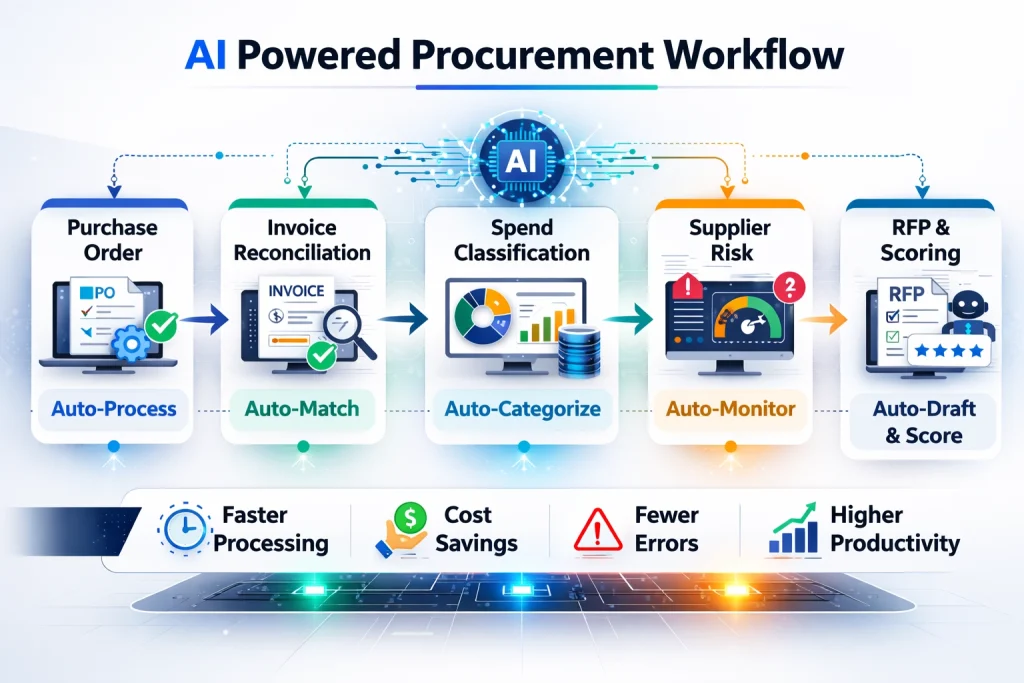
Understanding what AI replaces, versus what it changes, matters more than the fear of automation itself.
Tasks AI Is Already Handling
- Purchase order processing: AI can match, validate, and route POs with near-zero manual involvement
- RFP drafting and scoring: Generative AI tools can draft standard RFPs and score supplier responses against weighted criteria
- Invoice reconciliation: Machine learning models detect mismatches and exceptions faster than any manual review process
- Spend classification: AI categorizes unstructured spend data at scale, something that used to require entire teams
- Supplier risk monitoring: Agentic AI continuously scans news, financial filings, and ESG databases to flag supplier risk signals in real time
By conservative estimates, these routine tasks represent 50% to 80% of what many procurement coordinators and analysts spend their time on today.
What AI Cannot Replace
AI does not negotiate. It does not build trust with a strategic supplier over three years of difficult conversations. It does not read the room in a cross-functional meeting or decide when to push back on a business stakeholder. It does not make judgment calls in situations where the data is incomplete, contradictory, or politically sensitive.
These are precisely the capabilities that become more valuable as automation takes over the routine work.
How Procurement Roles Are Shifting
The future of procurement jobs is not elimination. It is elevation, but only for professionals who prepare for it.
Roles Most Affected by Automation
Procurement Coordinator and Data Entry Roles: These positions carry the highest automation risk. If the core function is processing, matching, or routing transactional data, AI can handle it faster and more accurately.
Junior Analyst Roles: Basic spend reporting, vendor database maintenance, and routine market research are increasingly handled by AI dashboards and generative tools.
Roles That Are Growing in Value
Strategic Sourcing Managers: As tactical work moves to AI, sourcing professionals who can build supplier strategies, manage complex negotiations, and align procurement to business goals become more valuable, not less.
Supplier Relationship Managers: AI can monitor suppliers. It cannot manage them. Professionals who develop deep supplier partnerships, drive joint innovation, and navigate disputes have a skill set that automation cannot replicate.
Procurement Data Strategists: Someone needs to own the data architecture that AI runs on. Professionals who understand both procurement operations and data governance are rare and increasingly in demand.
AI Implementation Leads: Every organization deploying AI in procurement needs someone who understands the business well enough to configure, validate, and improve those tools over time. This role is emerging now.
Agentic AI: The Next Disruption Most Teams Are Not Ready For
Most conversations about AI in procurement focus on tools that assist humans. Agentic AI goes further. It acts autonomously across multiple steps, making decisions, executing tasks, and adjusting based on results, all without waiting for human instruction at each step.
An agentic AI system in procurement might autonomously identify a supply risk, evaluate alternative suppliers, request quotes, score responses, and escalate a recommendation for human approval. That entire workflow, which could take a team several days, runs in hours.
This is not speculative. Platforms like Coupa, SAP Ariba, and GEP are already building agentic capabilities into their roadmaps.
The implication for procurement leaders is significant. Workforce upskilling needs to account not just for current AI tools but for agentic systems that will reshape entire workflows within the next three to five years.
The Workforce Upskilling Framework: A 4-Step Plan
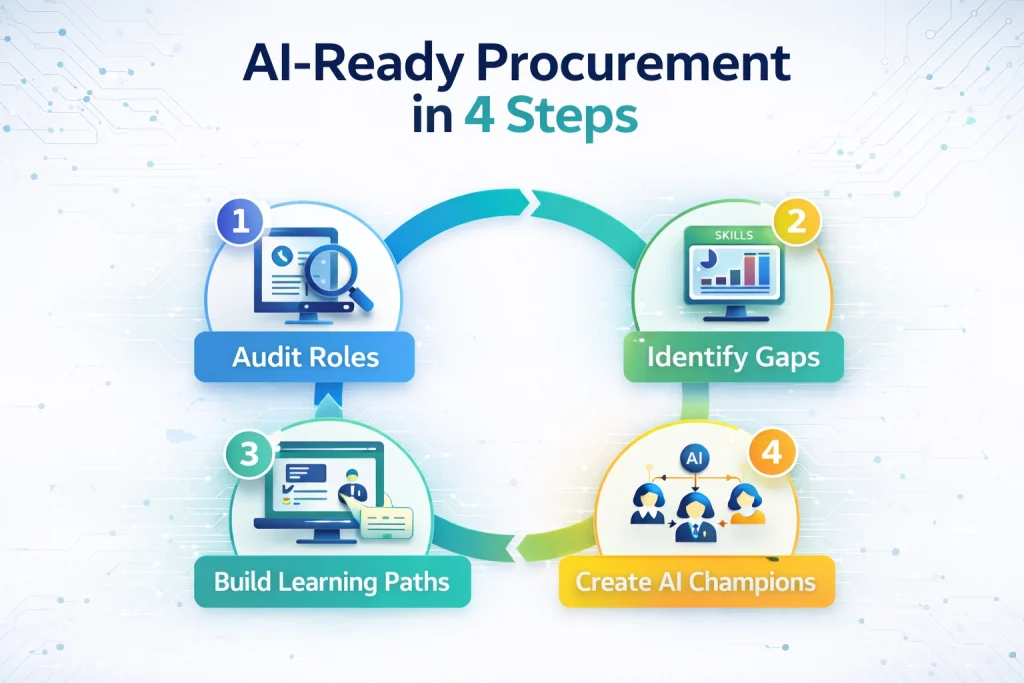
Organizations that will come out ahead are already building structured upskilling programs. Here is a framework you can apply now.
Step 1: Audit Current Role Risk Map every role in your procurement function against a simple grid: how much of the work is routine and data-driven versus judgment-based and relationship-dependent? High routine, low judgment roles carry the highest automation risk. Start your planning there.
Step 2: Identify the Skill Gaps. Run a skills assessment across your team focused on four areas: data literacy, AI tool proficiency, strategic sourcing capability, and cross-functional communication. Use the results to segment your team by readiness level, not by tenure or job title.
Step 3: Build Role-Specific Learning Paths. Do not run generic training programs. A procurement coordinator who needs to transition into a data validation role needs a different curriculum than a category manager building strategic sourcing skills. Match learning paths to specific role transitions, not to broad job levels.
Step 4: Create Internal AI Champions. Identify two or three team members who are both curious about AI and credible with their peers. Train them deeply, give them access to tools early, and make them the internal resource for questions and adoption. Peer-led adoption moves faster than top-down mandates.
Common Misconceptions About AI and Procurement Jobs
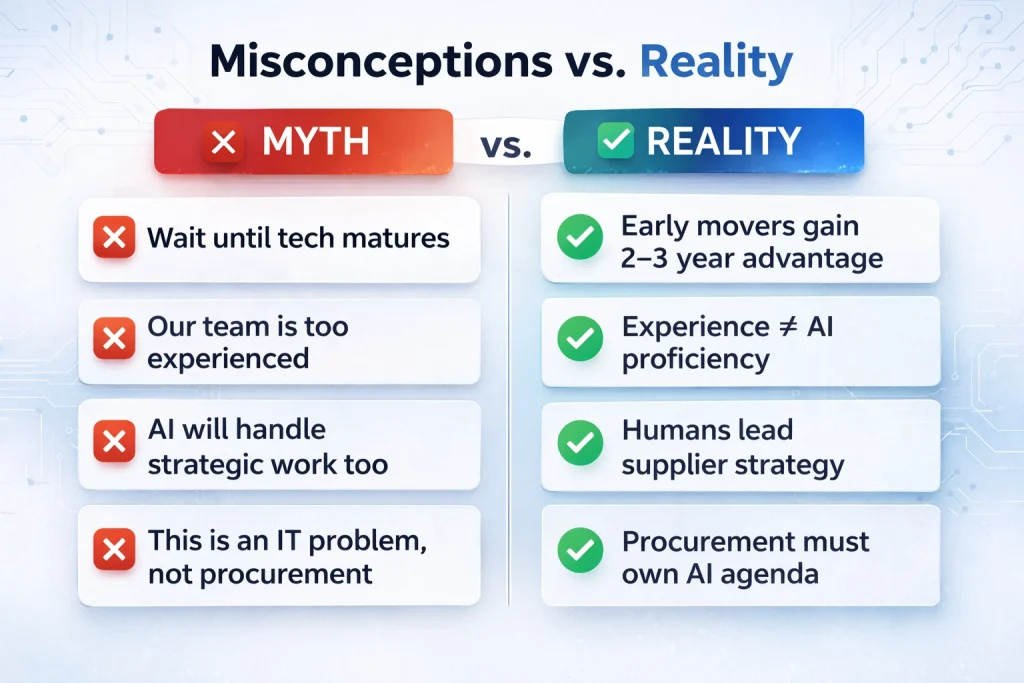
Misconception 1: “We will wait until the technology is more mature.” The organizations building AI-ready skills and data infrastructure now will have a two to three-year advantage over those who wait. Catching up later is significantly harder than building progressively.
Misconception 2: “Our team is too experienced to need retraining.” Experience in traditional sourcing is valuable. But experience does not automatically transfer to AI-augmented workflows. Senior professionals who resist upskilling are at higher career risk than junior ones who embrace it.
Misconception 3: “AI will handle the strategic work too, eventually.” Current AI, including the most advanced agentic systems, is not capable of the nuanced judgment, stakeholder influence, and long-term relationship building that defines strategic procurement. Those capabilities remain distinctly human for the foreseeable future.
Misconception 4: “This is an IT problem, not a procurement problem.” AI implementation in procurement fails most often because of misalignment between IT and procurement on data ownership, tool configuration, and workflow design. Procurement leaders must own this agenda, not delegate it.
Conclusion
The future of procurement jobs in the age of AI belongs to professionals and organizations that treat this moment as an upgrade opportunity rather than a threat. AI will take the transactional work. That is not a loss. It is a transfer of capacity toward the work that actually drives competitive advantage: strategic sourcing, supplier innovation, risk intelligence, and cross-functional leadership.
The organizations that win will be the ones who audit their skill gaps now, build structured upskilling paths before the urgency is critical, and position their procurement function as a driver of AI adoption rather than a recipient of it.
Start with your workforce readiness checklist. Identify your two highest-risk roles. Build one learning path this quarter. That is how transformation actually happens, one deliberate step at a time.
Ready to build an AI-ready procurement team? Use the framework and checklist in this article as your starting point, and share it with your leadership team to open the conversation.
FAQs
Will AI eliminate procurement jobs?
No. AI will automate routine, data-heavy tasks like PO processing and invoice matching, but it cannot negotiate, build supplier relationships, or make complex judgment calls. Procurement jobs are shifting upward in strategic value, not disappearing.
Which procurement roles are at the highest risk of automation?
Procurement coordinators, data entry specialists, and junior analysts face the highest risk. These roles are built around processing and routing structured data, which is exactly what AI handles best. Roles requiring negotiation, strategy, and relationship management are far more secure.
What is agentic AI and why does it matter for procurement teams?
Agentic AI can execute multi-step workflows autonomously, such as identifying a supply risk, sourcing alternatives, collecting quotes, and escalating a recommendation, all without waiting for human input at each stage. It is the next major wave after basic AI tools and will reshape entire procurement workflows within three to five years.
How big is the skills gap in procurement today?
Significant. Only 28% of procurement teams currently have AI-ready skills, and 74% of organizations lack the clean, connected data infrastructure that AI tools need to function effectively. This gap is growing as AI adoption accelerates faster than training programs can keep up.
Where should a procurement leader start with workforce upskilling?
Start by auditing role risk. Map every role against how much of the work is routine and data-driven versus judgment-based and relational. Focus your first upskilling investments on the roles most exposed to automation and build learning paths specific to those transitions, not generic training for the whole team.
What new procurement roles are emerging because of AI?
Three roles are growing fastest: Procurement Data Strategist (owns the data infrastructure AI runs on), AI Implementation Lead (configures and validates AI tools for procurement workflows), and Supplier Relationship Manager (handles the human-facing work AI cannot do). These are not future roles. They are being hired for now.
How do I get senior leadership to sponsor an AI transition plan?
Lead with business risk, not technology excitement. Show leaders the efficiency gap created by the skills mismatch, quantify the cost of falling behind competitors who are already upskilling, and present a structured plan with milestones. Leadership sponsors plans, not ideas.
Can experienced procurement professionals ignore AI upskilling?
No, and this is one of the most dangerous misconceptions. Experience in traditional sourcing does not transfer automatically to AI-augmented workflows. Senior professionals who resist upskilling carry more career risk than junior colleagues who embrace new tools early and build fluency quickly.
Who should own AI adoption in procurement: IT or procurement leadership?
Procurement leadership must own it. AI implementation fails most often because of misalignment between IT and procurement on data governance, tool configuration, and workflow design. IT can support the infrastructure, but procurement leaders must drive the strategy, requirements, and adoption accountability.
How do I know if my procurement team is ready for AI adoption?
Use the readiness checklist from the article. It covers four areas: data and infrastructure, skills and capability, strategy and leadership, and culture and change. If you cannot check off at least half the items in the first two categories, you have foundational work to do before deploying AI tools at scale.