
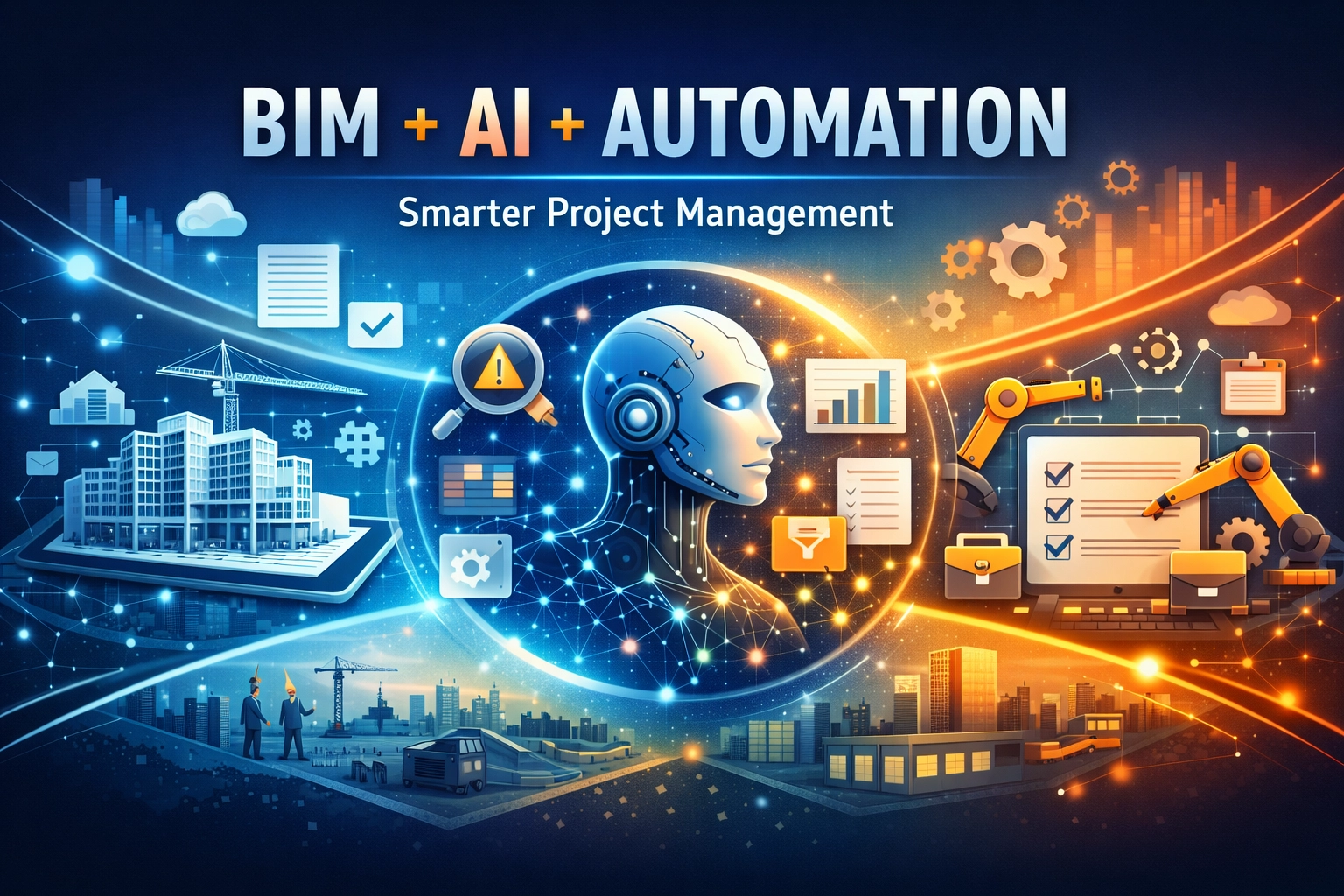
Digital transformation in project delivery isn’t just about “new software.” It’s about reducing delays, cutting rework, improving collaboration, and tightening contract control – using connected data and automated workflows. Three technologies are leading this shift:
- BIM (Building Information Modelling) for shared project information and coordination
- AI for faster decisions, risk detection, and contract intelligence
- Automation for workflow discipline (approvals, change control, compliance, reporting)
When these work together, project teams move from reactive firefighting to predictable delivery.
BIM organises project information and collaboration, AI turns project + contract data into insights, and automation enforces workflows – together improving cost, time, quality, and dispute prevention.
Table of Contents
Why contract and project management need a digital reset
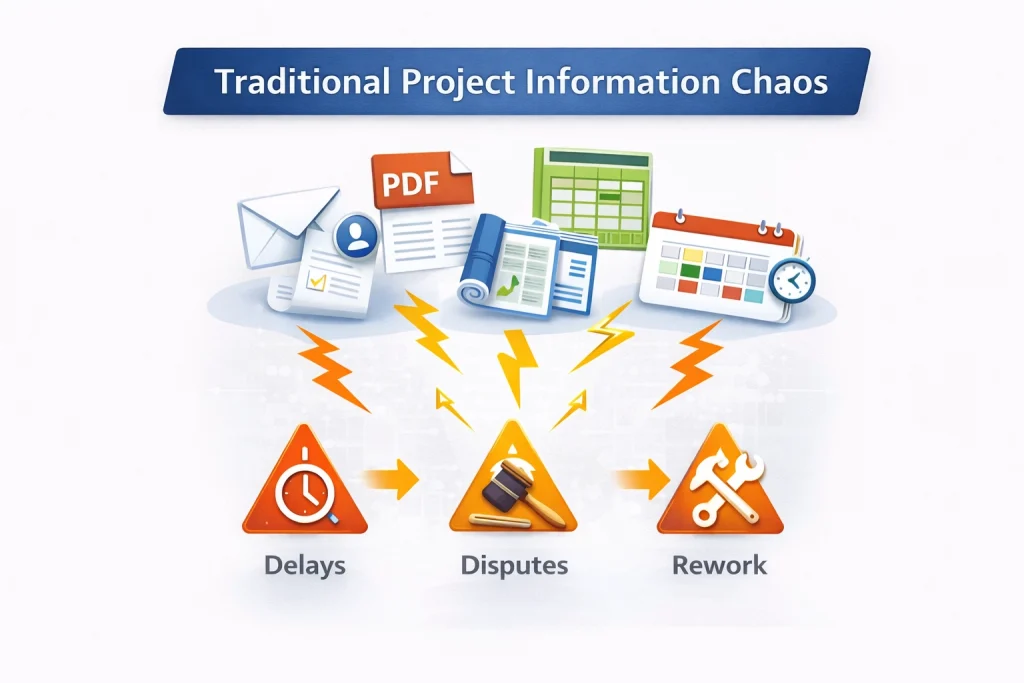
Traditional project controls often fail for one simple reason: information is fragmented – emails, PDFs, spreadsheets, siloed schedules, and disconnected site reports. That fragmentation creates:
- Late visibility on delays and risk
- Version-control issues (“Which drawing is latest?”)
- Weak audit trails for approvals, instructions, and variations
- Claims/disputes fueled by missing records and unclear scope
Digital tools solve this by creating a single source of truth, plus automated trails of decisions and approvals.
BIM: the backbone of modern project information management
BIM is not just 3D
In practical contract/project management terms, BIM is a way to manage structured project information (models + documents + data) across the lifecycle. The ISO 19650 series provides principles for information management using BIM.
The real game-changer: Common Data Environment (CDE)
A Common Data Environment (CDE) is an agreed, managed source for collecting, managing, and sharing project information – helping teams reduce duplication and mistakes.
Where BIM/CDE transforms contract & project management:
- RFIs & submittals: fewer conflicts because teams reference the same controlled information set
- Change management: model + drawing revisions are tracked and versioned, improving traceability
- Progress validation: model-linked quantities and work packages support more objective reporting
- Handover: structured asset data reduces chaos at commissioning/operations
(If your contracts rely on evidence, CDE discipline becomes dispute prevention.)
AI: from dashboards to decision support (and contract intelligence)
AI is increasingly used to streamline execution, enhance decision-making, and improve delivery precision in project environments.
At the enterprise level, the challenge isn’t “can AI work?” – it’s scaling it with the right processes, governance, and human validation.
AI in project management (practical use cases)
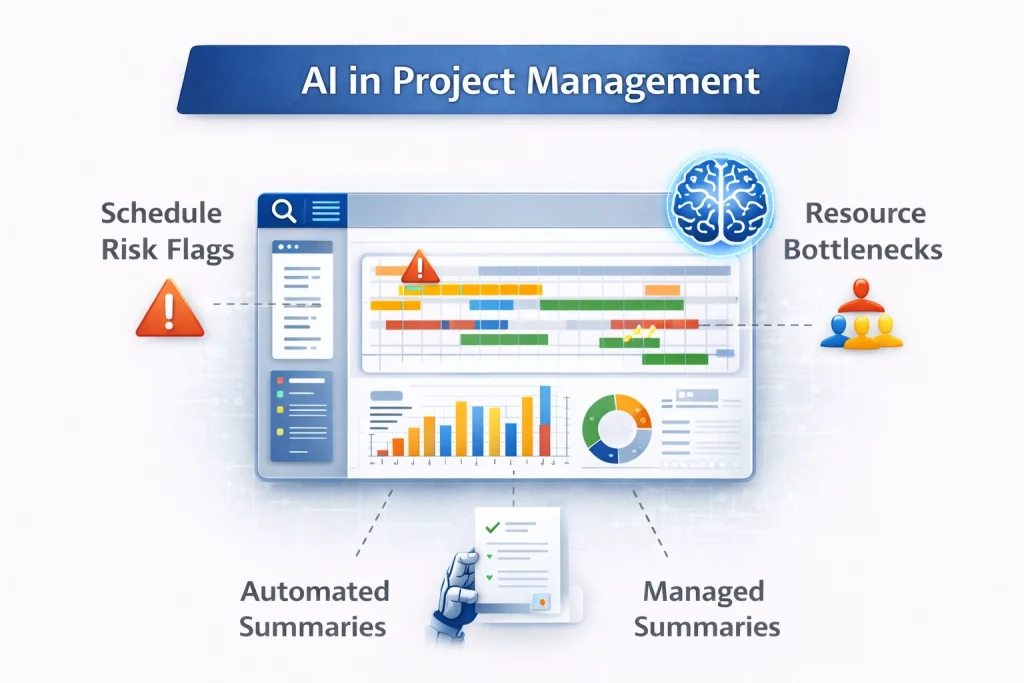
- Schedule risk prediction: flagging activities likely to slip based on historical patterns and current signals
- Resource optimisation: identifying bottlenecks across teams/vendors
- Automated reporting: summarising daily logs, MOMs, and progress notes into stakeholder-ready updates
- Issue clustering: detecting repeated causes of NCRs, rework, and site blockers
Research and professional bodies consistently highlight AI’s role in improving efficiency and decision-making in project management.
AI in contract management (CLM): the fastest ROI zone
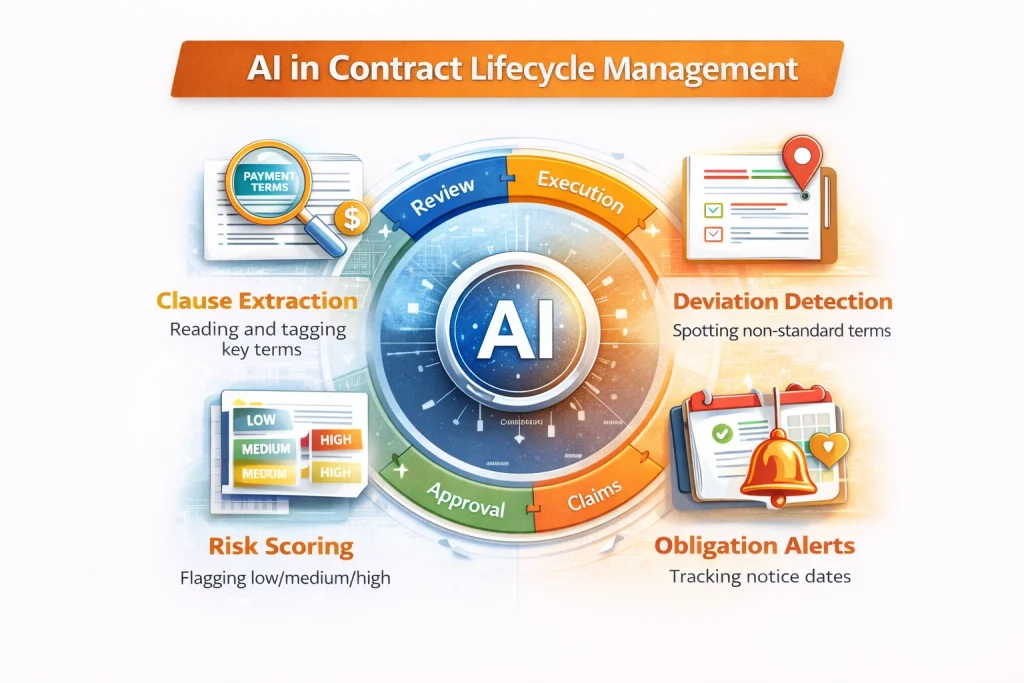
Contract Lifecycle Management (CLM) platforms increasingly use AI for:
- Clause extraction and key-term capture
- Deviation detection vs. standard playbooks/templates
- Risk scoring and obligation tracking
- Summaries and comparisons of drafts and redlines
This reduces review cycle time and increases compliance visibility.
AI helps contract teams by automatically extracting clauses, highlighting deviations from standards, and surfacing risk/obligation deadlines – so fewer issues slip past review. (
Automation: the “process glue” that makes BIM + AI actually work
Automation is what turns best practices into default behaviour.
What to automate first (high-impact workflows)
- Approvals & delegations (authority matrix-based routing)
- Change control (variation request → estimate → approval → instruction → record)
- Submittals & RFIs (due dates, reminders, escalation)
- Payment certification (milestones, measurements, supporting docs, audit trail)
- Compliance and obligation alerts (insurances, notices, warranties, LD triggers)
Automation ensures actions happen on time and evidence is captured consistently – critical when claims or disputes arise.
The “connected stack”: how BIM, AI, and automation work together
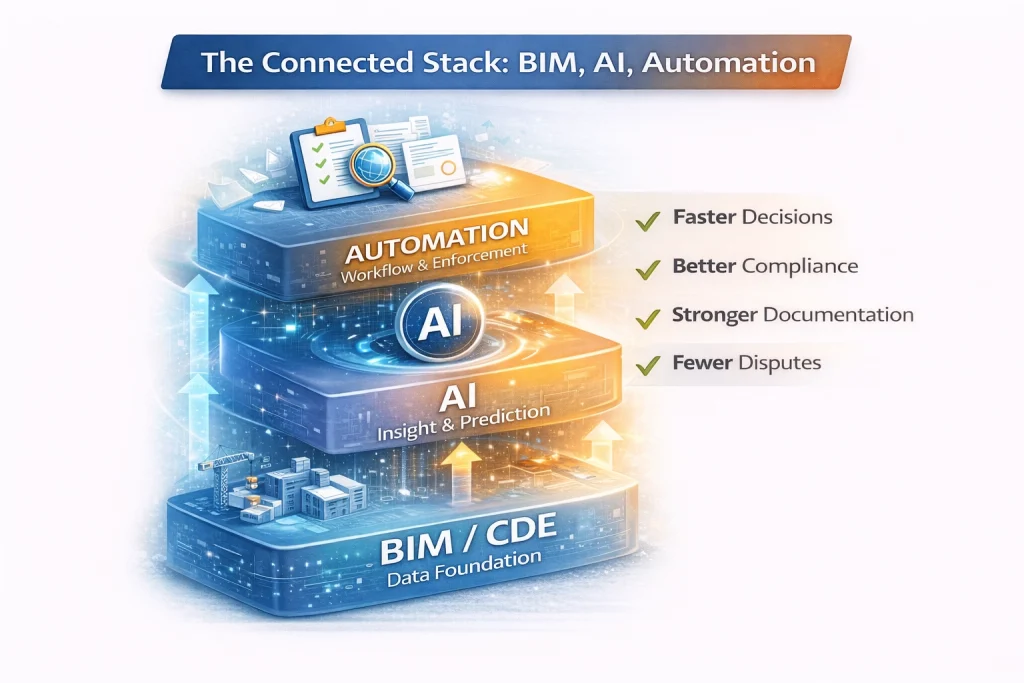
Think of it like this:
- BIM/CDE = trusted project data and controlled versions
- AI = intelligence layer (predict, summarise, detect risk)
- Automation = enforcement layer (workflow, approvals, audit trail)
When integrated, you get:
- Faster decisions
- Fewer coordination failures
- Better contract compliance
- Stronger documentation quality
- Reduced dispute probability
What changes for claims, disputes, and delay management
Claims and disputes often boil down to: records, causation, and entitlement. Digitisation helps because it improves:
- Time-stamped evidence trails (instructions, approvals, communications)
- Version-controlled information (who knew what, when)
- Structured progress data (planned vs actual clarity)
In the real world, that means fewer “he said / she said” gaps and more defensible project narratives.
Implementation roadmap: adopt without overwhelming the team
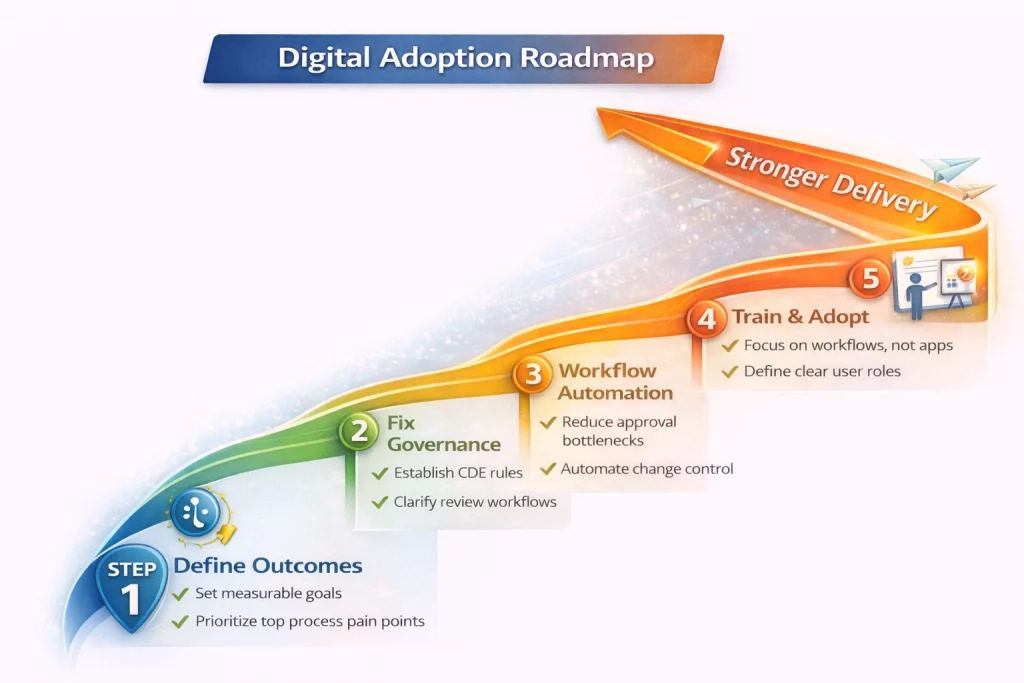
Step 1: Define the outcomes (not tools)
Pick 2–3 measurable goals:
- Reduce RFI cycle time by X%
- Improve variation approval time by X days
- Reduce rework/NCR frequency by X%
Step 2: Fix information governance (CDE rules)
Define naming, status codes, review/approval workflows, access control, and audit requirements aligned to ISO 19650-style information management.
Step 3: Start with “workflow wins”
Automate the workflows that create delays/disputes first (change control + submittals + approvals).
Step 4: Add AI where it’s safest and highest value
Common “good starts”:
- Contract clause extraction + risk flags
- Automated meeting minutes summaries
- Progress report drafting from structured inputs (Keep human validation – especially for contractual decisions.)
Step 5: Train people like it’s a system, not an app
Most failures are adoption failures – unclear roles, weak standards, inconsistent data entry, and no governance.
Where RKS Trainings and Rajeev Sharma fit naturally
If your audience includes procurement, commercial, or contract teams, it helps to connect digital tools to real contracting workflows – tendering, negotiation, contract administration, variations, and claims hygiene.
That’s exactly where practitioner-led capability building matters. In Gurugram, Noida, and Delhi NCR, professionals often work with consultants who understand both commercial outcomes and execution realities. For example, Rajeev Sharma (a Procurement Consultant in Gurugram, Noida, and Delhi NCR) works with teams on practical procurement and contracting discipline – so digital adoption supports stronger sourcing, clearer scope packaging, tighter contract controls, and cleaner audit trails. Through RKS Trainings, this typically translates into hands-on learning around workflows like change control, contract risk scanning, and vendor performance governance – so the tools don’t remain “IT projects,” but become operational habits.
Common mistakes to avoid (quick checklist)
- Buying tools before defining workflows
- No CDE governance → messy data → AI gives unreliable outputs
- Automating bad processes (you’ll just create faster chaos)
- No integration plan (BIM, schedule, cost, contracts remain siloed)
- Treating AI outputs as final (use human validation gates)
Conclusion
Digital tools are reshaping contract and project management by solving the root problem: fragmented information and inconsistent process execution.
- BIM + CDE improves collaboration and information control
- AI accelerates insight, risk detection, and contract intelligence
- Automation enforces workflow discipline and audit-ready trails
Adopt them with clear outcomes, strong governance, and focused workflow wins – and you’ll see real movement in cost, time, quality, and dispute risk.
Frequently Asked Questions
What is BIM in project management?
BIM is a method for managing structured project information (models + data + documents) across the asset lifecycle, enabling better coordination, fewer clashes, and improved information control – often supported by ISO 19650 information management principles.
What is a Common Data Environment (CDE)?
A CDE is an agreed source of information for collecting, managing, and sharing project information through a managed process – supporting collaboration, version control, and traceable approvals.
How does AI help contract management?
AI can extract key clauses, compare drafts to standard playbooks, highlight deviations, and support risk/compliance monitoring – reducing cycle time and improving contract visibility.
How does automation reduce project delays?
Automation speeds up approvals, escalations, and routine workflows (RFIs, submittals, change control), ensuring tasks don’t get stuck in email threads and that evidence is captured consistently.
Are AI agents always reliable for project decisions?
Not always. Industry research emphasizes that scaling AI requires clear processes, governance, and defined points where humans validate outputs – especially for high-stakes contractual decisions.