
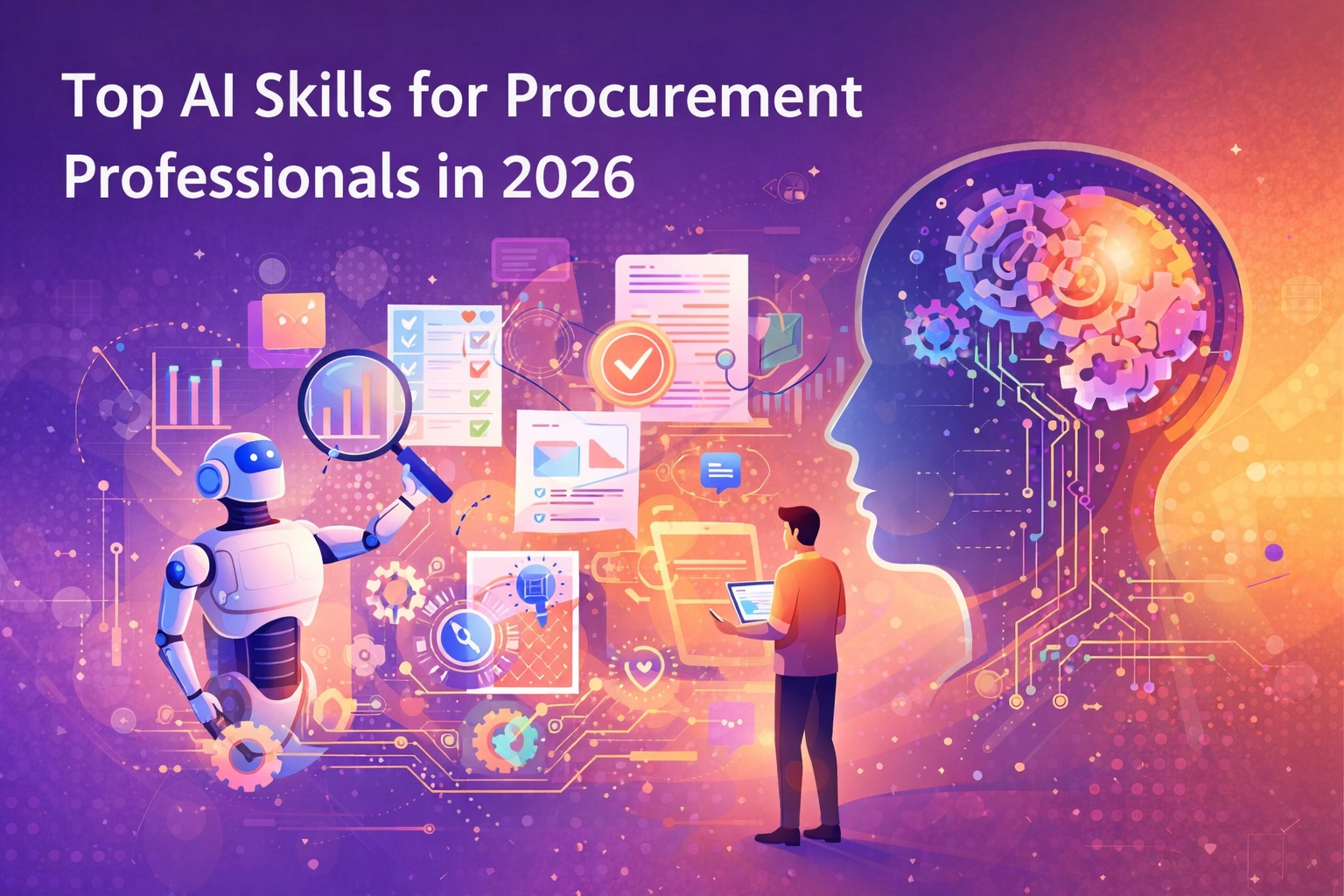
Procurement is changing faster than most professionals can keep up with. AI tools are already handling supplier screening, spend analysis, and contract review at companies like Siemens, Unilever, and Amazon. If you are still relying on spreadsheets and gut instinct, you are not just behind the curve. You are at risk.
This article gives you a clear, actionable roadmap. By the end, you will know exactly which AI skills matter most in procurement, why they matter, and how to start building them today.
Table of Contents
Who This Is For
This guide is written for mid-to-senior procurement professionals who:
- Have 5 or more years in sourcing, category management, or supply chain roles
- Are facing pressure to “do more with AI” but are not sure where to start
- Want to move from tactical execution into a more strategic, data-driven function
- Struggle with knowing which AI outputs to trust and which to question
Why AI Skills Are Now a Core Procurement Competency
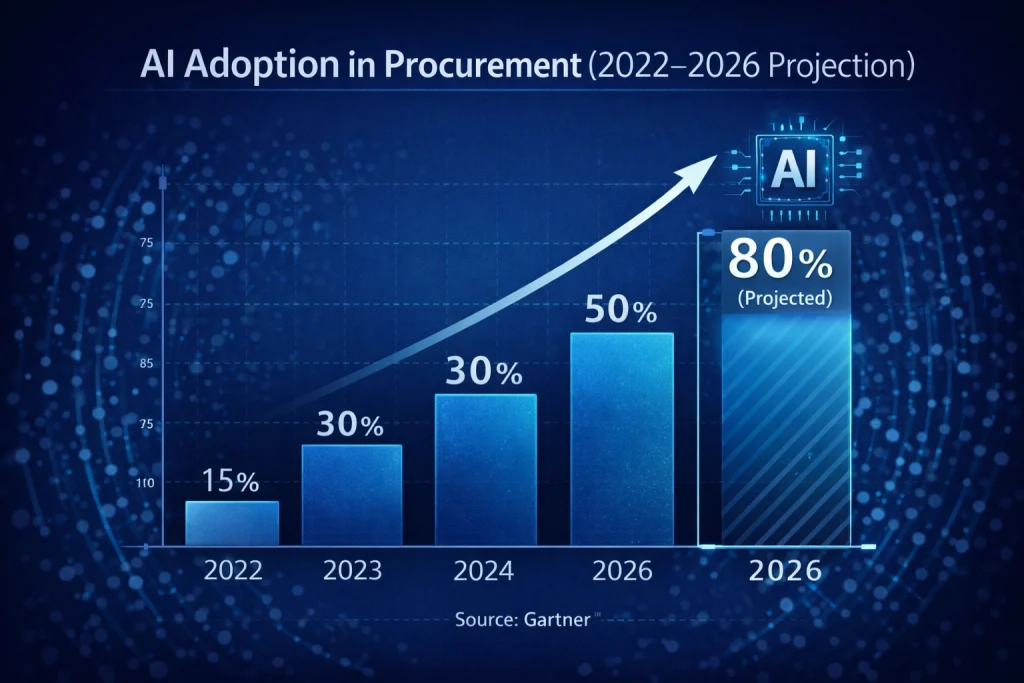
Gartner predicts that by 2026, 80% of procurement organizations will use AI-enabled tools for at least one core process. Yet adoption rates remain low because the skill gap is real. Most professionals know AI is important. Few know how to use it well.
The risk is not that AI will replace procurement professionals. The risk is that procurement professionals who know AI will replace those who do not.
The Top 10 AI Skills for Procurement Professionals
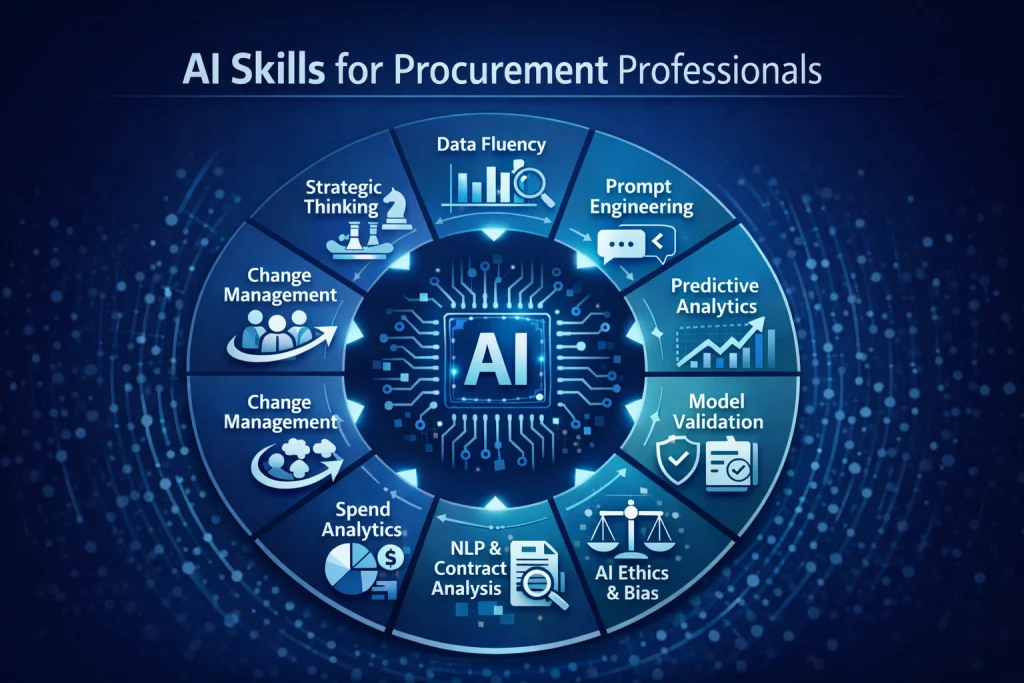
1. Data Fluency
What it is: The ability to read, interpret, and question data, even without being a data scientist.
Why it matters: AI models are only as good as the data they are trained on. If you cannot spot a biased sample or a missing variable, you will trust outputs you should not.
How to build it:
- Learn to read basic descriptive statistics (mean, median, standard deviation)
- Practice identifying data quality issues in your own spend data
- Take a free course on data literacy from Coursera or LinkedIn Learning
Example: A category manager at a manufacturing firm noticed that their AI-generated savings forecast was 30% higher than expected. She dug into the data and found the model was trained on pre-COVID pricing. That catch saved her team from a flawed negotiation strategy.
2. Prompt Engineering
What it is: Writing clear, structured inputs to get useful outputs from AI tools like ChatGPT, Claude, or Copilot.
Why it matters: Vague prompts produce vague results. Skilled, prompt engineering is the difference between a generic summary and a targeted competitive analysis.
How to build it:
- Use the format: Role + Task + Context + Constraints
- Example prompt: “You are a procurement analyst. Summarize the top 3 risk factors in this supplier’s financials. Focus on liquidity and debt ratios. Use plain language.”
- Practice daily with real procurement tasks like RFP drafting, supplier briefings, or market analysis
3. Predictive Analytics Interpretation
What it is: Understanding what AI-generated forecasts mean and when to act on them.
Why it matters: Tools like Coupa, Jaggaer, and GEP now surface predictive spend and risk scores. If you cannot interpret confidence intervals or understand why a prediction changed, you are flying blind.
How to build it:
- Learn the difference between correlation and causation
- Ask your vendor: “What data drives this score?” and “What is the margin of error?”
- Run parallel scenarios: compare AI predictions against your own expert judgment quarterly
4. AI Model Validation
What it is: The ability to test whether an AI output is accurate, fair, and fit for purpose.
Why it matters: AI tools can produce confident-sounding wrong answers. In procurement, a flawed risk score or incorrect contract clause could cost millions.
How to build it:
- Always ask: “What is this model optimized for, and is that aligned with my goal?”
- Cross-check AI outputs against at least one independent source
- Build a simple validation checklist (see framework below)
5. Supplier Risk Management with AI
What it is: Using AI tools to monitor supplier health, geopolitical risk, ESG compliance, and supply chain disruptions in real time.
Why it matters: Manual supplier monitoring is slow and incomplete. AI platforms like Riskmethods, Resilinc, and Supplier.io can identify risks weeks before they escalate into crises.
How to build it:
- Define which risk signals matter most for your category (financial, operational, reputational)
- Set alert thresholds and review cadences
- Do not outsource your judgment: use AI alerts as inputs, not decisions
Example: A global electronics buyer used AI monitoring to detect early signs of a key supplier’s cash flow stress. They diversified their supply 6 weeks before that supplier filed for protection. Manual monitoring would have missed it.
6. AI Ethics and Bias Awareness
What it is: Understanding how AI systems can embed and amplify bias, and knowing how to flag or correct it.
Why it matters: Supplier selection algorithms trained on historical data can disadvantage minority-owned or newer suppliers. If your AI perpetuates this, you face legal, reputational, and ethical risks.
How to build it:
- Ask vendors for bias audits and fairness documentation
- Review supplier shortlists for diversity representation
- Advocate internally for explainable AI tools (those that show why a recommendation was made)
7. Natural Language Processing (NLP) for Contract Analysis
What it is: Using AI tools to extract, compare, and flag key terms across large volumes of contracts.
Why it matters: Manual contract review is slow, expensive, and error-prone. NLP tools can scan thousands of contracts in hours to find liability gaps, missing clauses, or non-standard terms.
How to build it:
- Start with tools like LexCheck, Ironclad, or Kira Systems
- Learn to define what “good” looks like before running AI analysis (you set the criteria)
- Use AI output as a first pass. Always have a legally valid high-risk findings.
8. Spend Analytics and Category Intelligence
What it is: Using AI to identify savings opportunities, maverick spend, and pricing trends across your spend cube.
Why it matters: Traditional spend analysis is backward-looking. AI tools identify patterns and anomalies in real time, giving category managers a competitive edge.
How to build it:
- Get trained on your organization’s spend analytics platform (Coupa, SAP Ariba, Ivalua)
- Learn to segment spend by supplier, category, and business unit
- Ask AI to surface the top 10 anomalies in last quarter’s spend and investigate each one
9. Change Management and Cross-Functional AI Adoption
What it is: The ability to bring stakeholders along on AI adoption, address resistance, and build trust in new tools.
Why it matters: Most AI implementations fail not because of technology but because of people. Procurement professionals who can lead change are invaluable.
How to build it:
- Identify skeptics early and involve them in pilot testing
- Share early wins with data and stories
- Frame AI as a tool that removes low-value work, not one that eliminates jobs
10. Strategic Thinking in an AI-Augmented Role
What it is: Shifting your focus from transactional tasks (which AI handles) to judgment-intensive work like supplier strategy, risk governance, and stakeholder influence.
Why it matters: As AI handles more operational work, your value shifts to areas that require context, relationships, and ethical judgment.
How to build it:
- Audit your current workload: which tasks could AI handle in the next 12 months?
- Invest time in supplier relationship management, internal stakeholder engagement, and category strategy
- Position yourself as the person who decides what AI should optimize for, not just the one who runs it
Practical Step-by-Step Framework to Build AI Skills
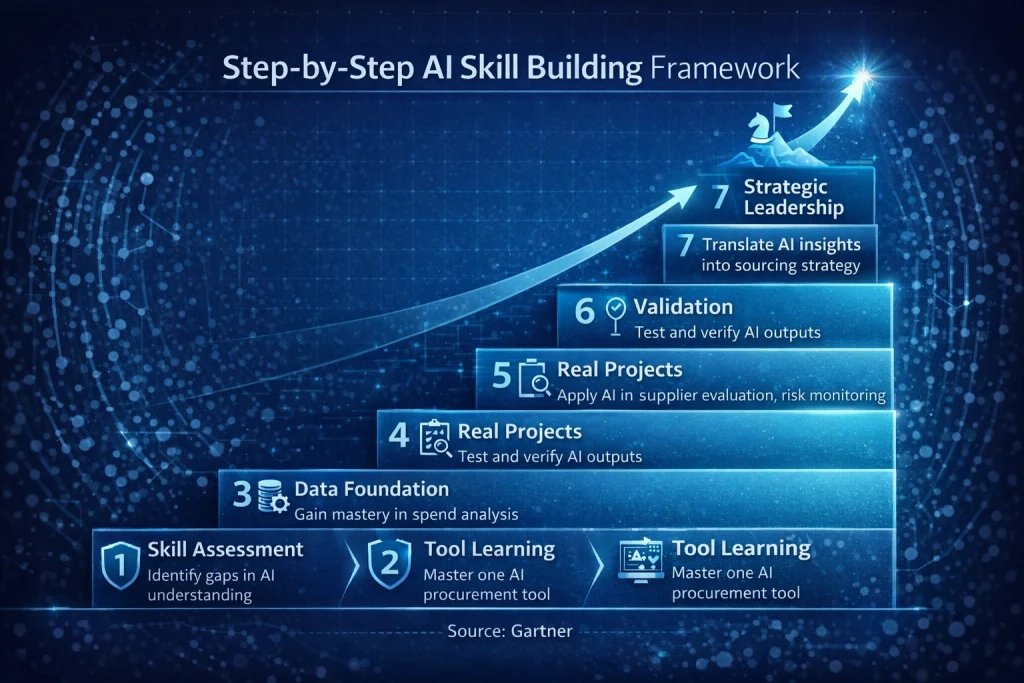
Step 1: Assess Current Skills
Identify gaps in:
- Data understanding
- AI awareness
- Digital tool experience
Honest assessment helps prioritize learning.
Step 2: Start with Data Skills
Focus on:
- Spend analysis
- Supplier performance metrics
- Dashboard interpretation
A strong data foundation supports all AI skills.
Step 3: Learn One AI Tool
Choose a procurement tool used in your organization. Master it before moving to others.
Step 4: Practice Prompt Engineering
Use AI tools weekly. Test prompts. Compare outputs.
Step 5: Apply AI in Real Projects
Examples:
- Supplier evaluation
- Contract analysis
- Risk monitoring
Practical application builds confidence.
Step 6: Validate Insights
Never act without verification.
Step 7: Develop Strategic Application
Translate insights into sourcing strategies.
Common Mistakes Procurement Professionals Make with AI
Trusting the output without questioning the input. AI tools do not know what they do not know. If your data is incomplete or outdated, the AI will confidently produce wrong answers.
Treating AI as a decision-maker. AI surfaces options and patterns. You make decisions. Never let a risk score or recommendation bypass your judgment without review.
Waiting until you feel “ready.” There is no perfect moment. Start with one tool, one use case, and one team. Learn by doing.
Ignoring the human side of adoption. Your colleagues’ resistance to AI is often more about trust than technology. Address that directly.
Conclusion
The procurement professionals who thrive in the next five years will not be the ones who fear AI. They will be the ones who understand it well enough to direct it, challenge it, and use it to deliver results no spreadsheet ever could.
Start with data fluency and prompt engineering. Add model validation and ethical awareness. Then build toward strategic leadership in an AI-enabled function.
The skills are learnable. The opportunity is real. The time to start is now.
Ready to take the next step? Download our free AI Readiness Assessment for Procurement Teams, or share this article with a colleague who is navigating the same challenges.
Read : ChatGPT for Procurement and Contract Management: Real Use Cases (That Actually Work)
FAQs
Do I need a technical background to learn these AI skills?
No. All 10 skills are designed for procurement professionals, not data scientists. If you can write a clear brief or read a supplier report, you have the foundation to start.
Which skill should I start with if I am completely new to AI?
Start with prompt engineering. It requires no special tools, delivers results immediately, and builds the habit of thinking clearly about what you need from AI.
Will AI replace procurement professionals?
Not the ones who adapt. AI handles repetitive tasks, but supplier relationships, ethical judgment, and strategic decisions still require human expertise. The real risk is being replaced by a colleague who knows AI better than you.
How long does it take to build these skills?
Prompt engineering can improve within weeks of daily practice. Data fluency and model validation take two to three months. Consistency matters more than speed.
What is the biggest mistake procurement teams make with AI?
Trusting AI output without questioning the input. If your data is outdated or incomplete, the AI will produce confident but wrong answers. Always validate before acting.
How do I know if an AI tool is biased in supplier selection?
Ask the vendor for a bias audit and review shortlists for diversity gaps. Favor tools that explain why a recommendation was made, not just what the recommendation is.
Can AI really improve contract analysis?
Yes. NLP tools like Kira Systems or Ironclad can scan thousands of contracts in hours to find missing clauses and liability gaps. Use them as a first pass, then have legal validate high-risk findings.
What does data fluency mean in practice for procurement?
It means you can read basic statistics, spot data quality issues in your spend data, and know when an AI output looks too good to be true. You do not need to build models, just interpret and question them.
How do I get my team to adopt AI tools without resistance?
Involve skeptics early in pilot testing, share wins with data and real stories, and frame AI as something that removes low-value work rather than eliminates jobs. Trust is built through transparency, not announcements.
How do I know where I stand across these 10 skills?
Use the AI Readiness Checklist in the article. It has nine self-assessment statements across three levels: Foundation, Intermediate, and Advanced. Complete it honestly and focus your energy on the first level where you cannot check every box.