
Key Takeaways:
- ChatGPT can remove 30 to 60 percent of repetitive drafting, summarizing, and analysis work in procurement and contracts.
- RFP and RFQ documents that take two days to draft can be produced in approximately 20 minutes using ChatGPT.
- ChatGPT works best as a second reviewer, flagging missing clauses, ambiguous language, and non-standard contract terms for human review.
- Never paste sensitive contract data, pricing, or vendor bank details into consumer AI tools without proper enterprise data controls.
- Negotiation prep packs, including BATNA options, concession plans, and supplier pushback responses, deliver the highest immediate performance improvement.
- ChatGPT can extract obligations, renewal dates, notice periods, service levels, and audit rights from contracts into structured tables.
- Three governance lanes covering safe, controlled, and restricted data use help organizations adopt AI without creating compliance or legal risks.
- AI accelerates procurement drafting and analysis but still requires human judgment for strategy, stakeholder alignment, and final commercial decisions.
Automating broken procurement processes with AI produces faster chaos, not better outcomes. Fix processes before adding AI tools.
If you’re in procurement or contracts, you already know the pain: emails everywhere, PDFs no one reads, versions of the same clause floating around, and approvals that move slower than a Monday morning site meeting.
ChatGPT doesn’t magically “fix procurement.” But used correctly, it can remove 30–60% of the repetitive drafting, summarising, and analysis work – so your team spends more time on real commercial decisions.
ChatGPT for Procurement and Contract Management by accelerating drafting (RFPs, emails, scope), extracting and summarising contract terms, generating negotiation strategies, and improving knowledge reuse – while requiring strong data controls and human review for risk decisions.
Table of Contents
Why ChatGPT is exploding in procurement + contracts right now
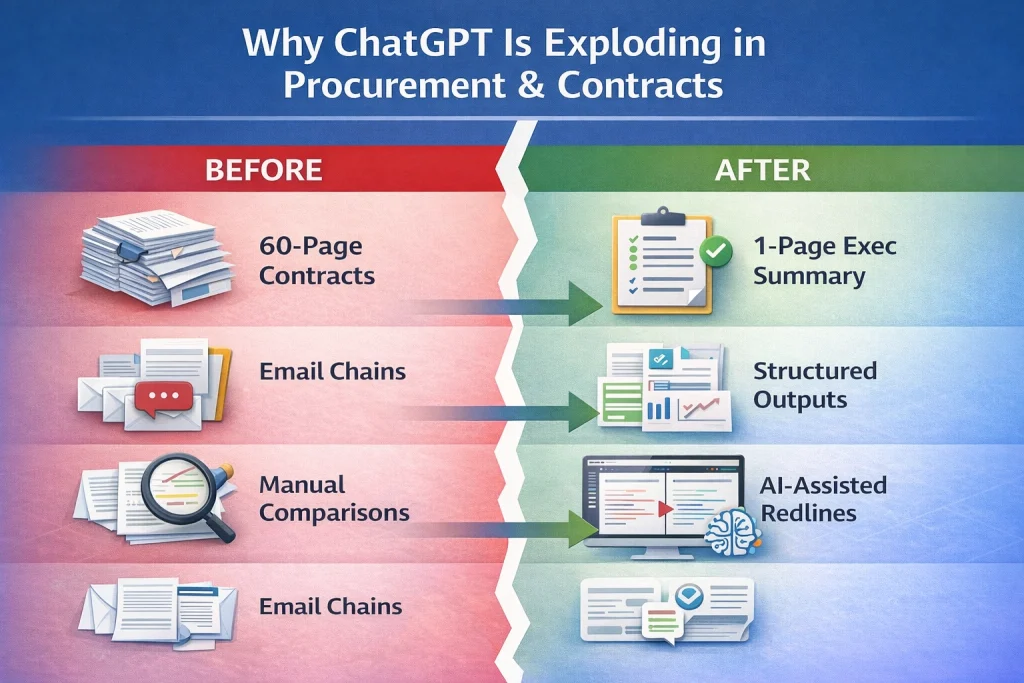
Because it’s great at tasks humans hate but must do:
- summarising long docs
- rewriting and standardising language
- comparing two versions and spotting changes
- turning messy notes into clean outputs
- generating structured checklists and playbooks
And when you combine it with business-grade privacy controls (which is important), it becomes usable for organisations that care about compliance. OpenAI’s enterprise/business offerings state they don’t train on your business data by default and provide data retention controls for qualifying orgs.
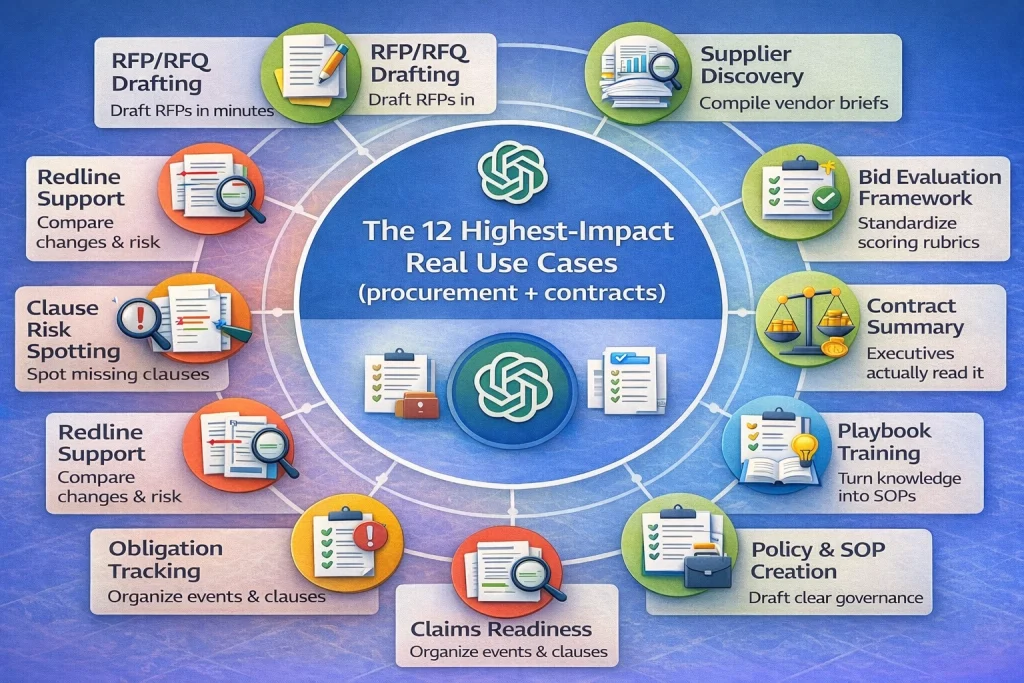
The 12 highest-impact real use cases (procurement + contracts)
1) RFP/RFQ drafting in 20 minutes instead of 2 days
What you feed it: your scope bullets, constraints, SLA expectations, bidder instructions
What you get: a structured RFx document, evaluation criteria, and bidder questions
Best for: indirect categories, services, software, routine sourcing events
Human still decides: specs, commercial terms, bidder shortlist
2) Supplier discovery + “first-pass” vendor profiles
ChatGPT can turn scattered info into a supplier brief:
- What the supplier does
- likely capabilities
- questions to validate
- red flags to investigate
Use it as a research assistant, not as a truth machine.
3) Bid evaluation framework + scoring rubrics (fast)
You can generate:
- weighted criteria
- technical vs commercial separation
- compliance checklists
- bid clarification question sets
4) Contract summary that people actually read
Instead of “please read 62 pages,” you produce:
- 1-page executive summary
- risk bullets
- obligations + deadlines
- payment & termination highlights
This aligns with how AI is often used in contract lifecycle management to turn contracts into actionable intelligence (summaries, extraction, risk insights).
5) Clause risk spotting (as a second reviewer)
ChatGPT can flag:
- missing clauses (limitation of liability, confidentiality, IP, indemnity)
- ambiguous language
- non-standard payment/termination triggers
Modern CLM commentary consistently highlights AI’s role in risk detection, extraction, and workflow automation, but it’s not a replacement for legal judgment.
6) Redline support: “Explain what changed and why it matters.”
Give it:
- Supplier draft clause
- Your standard clause/playbook position Ask for:
- differences
- risk impact
- acceptable fallback options
- suggested negotiation wording
(You still approve final positions.)
7) Obligation tracking starter list (contracts → actions)
ChatGPT can extract:
- renewal dates, notice periods
- reporting obligations
- insurance requirements
- service levels and penalties
- audit rights
Many CLM best-practice guides emphasise extracting key terms into structured fields and tracking obligations for governance.
8) Negotiation prep pack (your best ROI)
Generate:
- negotiation strategy by objective (price, SLA, LDs, warranty)
- BATNA options
- concession plan (give/get)
- supplier pushback responses
- “must-have vs nice-to-have” list
This is where teams feel immediate performance improvement.
9) Claims/dispute readiness (EPC & projects)
For project contracts, ChatGPT can help structure:
- event timeline narrative
- correspondence index checklist
- clause mapping (notice, EOT, variations)
- key evidence gaps to fill
It won’t “win” disputes. But it will make your story cleaner and faster.
10) Policy + SOP creation for procurement governance
Ask it to draft:
- delegation of authority matrix templates
- procurement SOPs
- bid ethics policy
- conflict-of-interest declarations
- vendor onboarding checklists
Then you align with internal policy and legal requirements.
11) Spend categorisation & insight brainstorming (with guardrails)
If you paste sensitive spend files into consumer tools, that’s risky.
But with properly controlled environments, you can use AI to:
- propose category trees
- Suggest consolidation opportunities
- Detect duplicate vendors (if the data is safe to use)
For AI risk governance, frameworks like the NIST AI Risk Management Framework are commonly referenced for implementing trustworthy AI practices (govern, map, measure, manage).
12) Training & enablement: turning seniors’ knowledge into playbooks
You can “extract” expertise:
- best clause positions by category
- common negotiation traps
- templates for emails, notices, escalation
This is extremely valuable in organisations with high attrition.
The prompt pack (copy/paste) – made for procurement + contracts
A) RFQ/RFP builder
Prompt
You are a procurement manager. Create an RFQ for [category].
Include: scope, deliverables, service levels, pricing template, bidder questions, compliance requirements, timelines, and evaluation criteria.
Context: [paste bullets].
Output in a professional document structure with headings.
B) Contract “executive summary.”
Summarise this contract for a CFO in 12 bullets: scope, term, fees, payment terms, termination, liability cap, indemnities, IP, confidentiality, SLAs/penalties, change control, and dispute resolution.
Then list the top 10 risks and suggested mitigation actions.
C) Clause comparison
Compare Clause A (our standard) vs Clause B (supplier).
Identify differences, risk impact, and propose 2 fallback options that protect us while being commercially realistic.
D) Obligation tracker starter
Extract all obligations and deadlines from this contract.
Output as a table: Obligation | Owner (suggest) | Frequency | Deadline/Trigger | Evidence required | Risk if missed.
E) Negotiation plan (give/get)
Create a negotiation strategy for [supplier] on [deal].
Objectives: [list].
Constraints: [list].
Provide: opening position, target, walk-away, concession plan (give/get), likely supplier pushback, and responses.
The “don’t be stupid” section (this is where most teams fail 😄)
Don’t paste sensitive data into the wrong environment
Consumer AI tools may use content to improve models depending on settings; business offerings differ. OpenAI’s guidance highlights data controls and that business products don’t train on your business data by default.
Rule of thumb:
- For real contract text, pricing, vendor bank details, or confidential project info → use enterprise/business controls or an approved workflow.
OpenAI also notes retention controls for business data and the ability (for qualifying orgs) to configure retention, including zero data retention on the API platform.
Don’t treat outputs as legal advice
Use ChatGPT as:
- drafter
- summarizer
- analyst
- Second reviewer Not as final authority. AI risk governance frameworks exist for a reason.
Don’t automate bad processes
If your change control is broken, AI will just produce faster chaos.
A simple governance model that won’t scare your leadership

If you want adoption without drama, implement three lanes:
Lane 1 – Safe (no sensitive data):
RFx drafting, email templates, SOP drafts, negotiation scripts.
Lane 2 – Controlled (masked data / approved environment):
Contract summaries, clause comparisons, and obligation extraction.
Lane 3 – Restricted (human-only or specialised tools):
Final legal opinions, signature decisions, regulated data, and bank details.
This aligns well with widely used AI risk governance thinking: define risk, set controls, monitor, and continuously improve.
Bridging AI Tools with Real-World Procurement and Contracting Practices
AI tools like ChatGPT deliver value only when they are embedded within disciplined procurement and contract management processes. Without clear scope definition, negotiation frameworks, approval workflows, and documentation standards, even the most advanced AI outputs remain underutilised or create inconsistent results.
This is why many organisations focus not only on adopting digital tools, but also on strengthening the commercial fundamentals that govern how those tools are used. In procurement and contracting environments, this includes structured RFx processes, negotiation playbooks, contract risk frameworks, and governance models that define accountability and escalation.
In regions such as Gurugram, Noida, and Delhi NCR, procurement teams often rely on practitioner-led capability building to make AI adoption practical rather than experimental. Professionals like Rajeev Sharma, a Procurement Consultant in Gurugram, Noida, and Delhi NCR, work with teams to align tools like ChatGPT with real sourcing, negotiation, and contract administration workflows. Through RKS Trainings, the focus remains on applying AI within proven procurement structures – so teams gain speed and consistency without compromising commercial control or risk management.
The result is not “AI-generated documents,” but better procurement decisions, cleaner contract execution, and stronger audit-ready processes.
Conclusion
ChatGPT is basically a junior analyst who never sleeps – great at drafts, summaries, comparisons, and turning chaos into structure.
But like any junior, it needs supervision, rules, and a playbook.
If you apply it with clear governance and strong commercial basics, you’ll see faster cycles, better documentation, and sharper negotiation prep – without turning procurement into an “AI experiment.”
Frequently Asked Questions
Can ChatGPT review contracts?
Yes – ChatGPT can summarise, extract clauses, highlight deviations, and suggest questions. But final decisions should be reviewed by legal/commercial owners, and your organisation should use appropriate data controls.
What are the best ChatGPT use cases in procurement?
RFx drafting, supplier communication templates, bid evaluation rubrics, negotiation planning, and policy/SOP drafting are high-ROI and typically low risk when sensitive data is avoided.
Is ChatGPT safe for procurement data?
It depends on the product and settings. OpenAI describes differences between consumer and business offerings and provides enterprise privacy commitments and data controls for business users.
How does AI help contract compliance?
AI can extract obligations, monitor deadlines, flag risky clauses, and convert contracts into structured data – common CLM practices described by legal and CLM vendors.
Will ChatGPT replace procurement professionals?
No. It replaces repetitive drafting and analysis tasks, but procurement still needs human judgment: stakeholder alignment, negotiation, supplier strategy, governance, and accountability.