

Key takeaways:
- Procurement planning for capital projects defines what to procure, when to procure, how to procure, and from whom.
- Capital project procurement is strategic, not transactional. It directly influences cost control, schedule certainty, and overall project success.
- Without a clear procurement strategy, capital projects face budget overruns, supplier delays, contractual disputes, and poor project outcomes.
- Choosing between EPC and EPCM contracting models depends on project complexity, organizational capability, and the team’s overall risk appetite.
- Long-lead equipment planning is critical. Late procurement of major items causes construction delays that are extremely difficult to recover.
- Early supplier market analysis helps teams identify vendor capacity gaps, financial risks, and sourcing constraints before project execution begins.
- Procurement planning must start at the concept and feasibility stage, not after engineering and design work is already complete.
- Total cost of ownership principles help procurement teams control capital project budgets beyond just the initial purchase price.
- Strong procurement governance includes clear approval matrices, reporting mechanisms, and ESG compliance throughout the full project lifecycle.
Digital procurement tools, including ERP platforms, analytics dashboards, and contract management systems, improve visibility across complex capital projects.
Capital projects – such as infrastructure developments, industrial plants, large construction programs, and engineering-led investments – are defined by high value, long timelines, and irreversible commercial decisions. In such environments, success or failure is often determined long before execution begins. This is where procurement planning and strategy development for capital projects becomes critical.
Unlike routine operational procurement, capital project procurement involves complex contracting models, long-lead items, supplier capacity constraints, regulatory compliance, and schedule-driven decision-making. A well-defined procurement strategy ensures cost control, risk mitigation, and timely project delivery while aligning procurement actions with overall project objectives.
Table of Contents
What is Procurement Planning in Capital Projects?
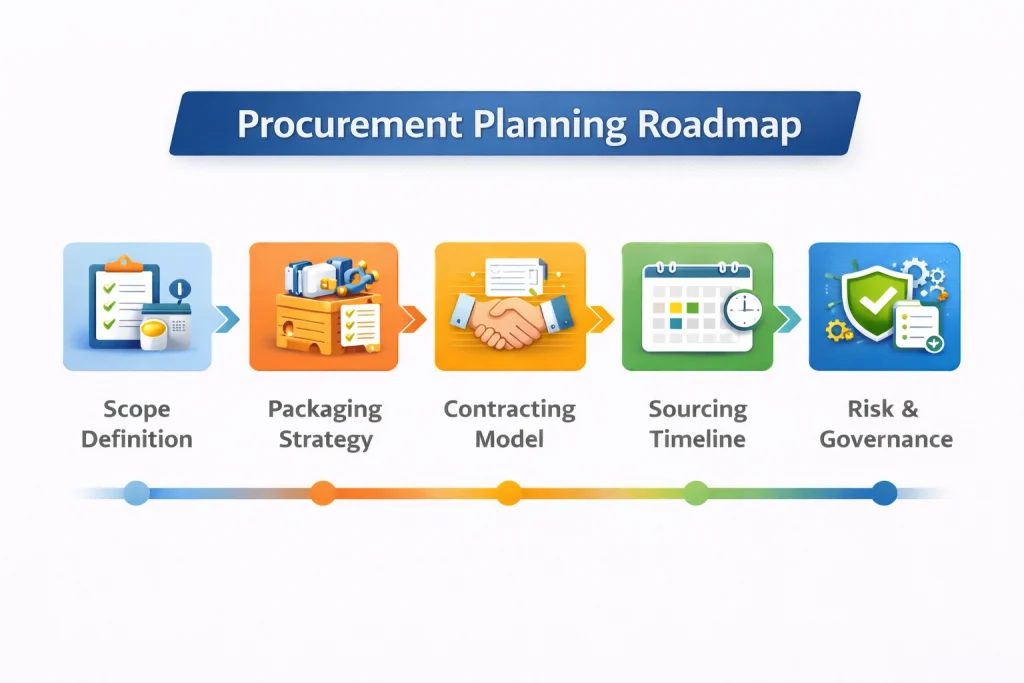
Procurement planning for capital projects is the structured process of defining what to procure, when to procure, how to procure, and from whom, across the entire project lifecycle.
It includes:
- Identifying procurement scope and packages
- Developing a procurement roadmap and timelines
- Selecting appropriate contracting and sourcing strategies
- Aligning procurement with project execution strategy (PES)
- Managing risks related to cost, schedule, and supply markets
Effective procurement planning transforms procurement from a transactional function into a strategic enabler of capital project success.
Why Procurement Strategy Development is Critical for Capital Projects
Capital projects are exposed to unique challenges:
- High capital expenditure and cost escalation risk
- Long-lead equipment and material dependencies
- Interface risks between multiple contractors and vendors
- Regulatory, statutory, and ESG compliance requirements
- Global supply chain volatility
Without a clear procurement strategy for capital projects, organisations face delays, budget overruns, contractual disputes, and compromised project outcomes.
Strategic procurement planning enables:
- Predictable costs through early market engagement
- Schedule certainty through lead-time management
- Optimised contract packaging and risk allocation
- Supplier alignment with project objectives
Key Elements of Procurement Planning and Strategy Development
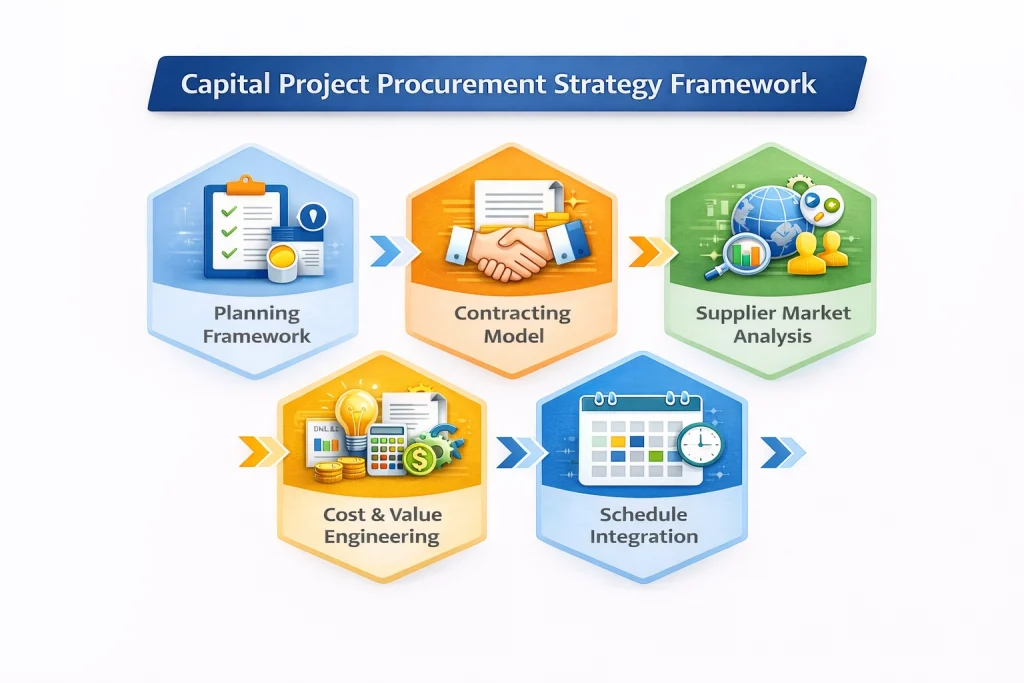
1. Procurement Planning Framework for Capital Projects
A robust procurement planning framework typically covers:
- Spend mapping and procurement scope definition
- Make-or-buy decisions
- Packaging and lotting strategy
- Contracting and tendering approach
- Governance and approval mechanisms
This framework ensures procurement decisions are structured, transparent, and aligned with capital project priorities.
2. Contracting Strategy and Commercial Models
Selecting the right contracting strategy for capital projects is a cornerstone of procurement strategy development.
Common models include:
- EPC (Engineering, Procurement, Construction)
- EPCM (Engineering, Procurement, Construction Management)
- Multiple-package contracting
- Turnkey and hybrid models
Each model has implications for risk allocation, cost control, and schedule management. Procurement strategy must evaluate EPC vs EPCM procurement based on project complexity, organisational capability, and risk appetite.
3. Supplier Market Analysis and Sourcing Strategy
Capital project procurement requires deep supplier market analysis, including:
- Vendor capacity and capability assessment
- Global vs local sourcing strategy
- Long-lead item procurement planning
- Supplier financial and operational risk assessment
Early engagement with critical equipment suppliers reduces schedule risk and enables informed sourcing decisions.
4. Cost Management and Value Engineering
Procurement plays a central role in capital project cost management by:
- Supporting accurate cost estimation and benchmarking
- Applying total cost of ownership (TCO) principles
- Enabling value engineering and specification optimisation
- Managing price escalation and currency exposure
Strategic procurement planning directly contributes to budget discipline and financial predictability.
5. Schedule-Driven Procurement Planning
In capital projects, procurement timelines are dictated by the project schedule. Procurement lead time management ensures that materials and equipment are delivered in line with construction and commissioning milestones.
Key practices include:
- Procurement phasing aligned to project execution
- Expediting and logistics planning
- Interface management across contractors
- Mitigation planning for supplier delays
6. Risk Management, Governance, and Compliance
A strong procurement risk management strategy addresses:
- Supply chain and vendor risks
- Contractual and commercial exposure
- Regulatory and statutory compliance
- ESG and ethical procurement obligations
Clear governance structures, approval matrices, and reporting mechanisms ensure control throughout the procurement lifecycle.
Procurement Planning Across the Capital Project Lifecycle
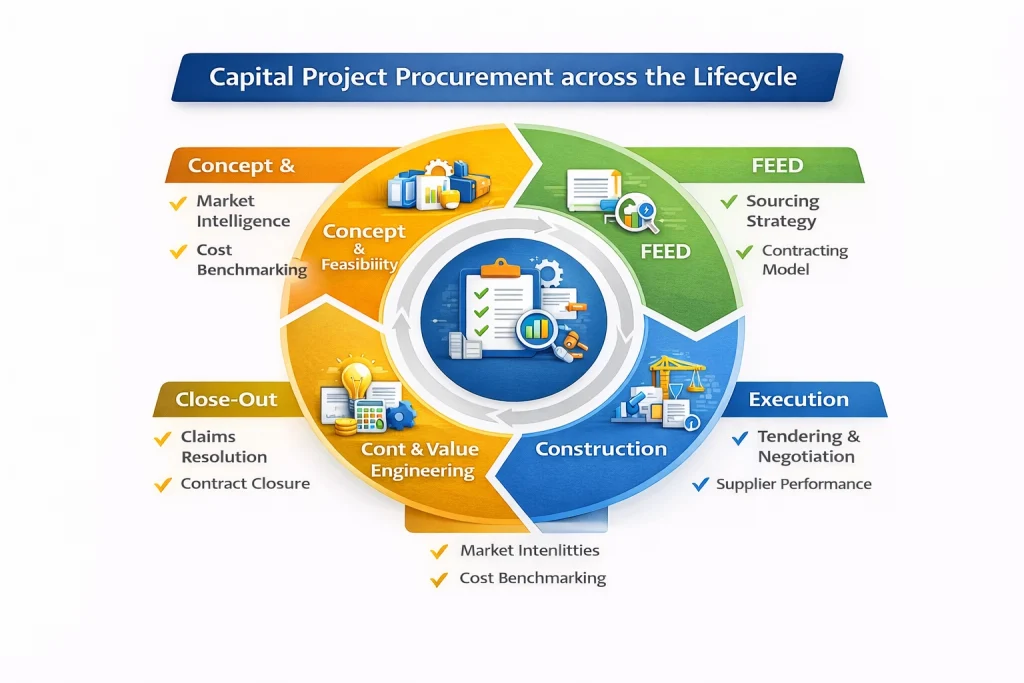
Procurement planning must be embedded across all project phases:
| Project Phase | Procurement Focus |
|---|---|
| Concept & Feasibility | Market intelligence, cost benchmarking |
| FEED / Front-End Planning | Sourcing strategy, contracting model |
| Execution | Tendering, negotiation, and contract management |
| Construction | Expediting, logistics, supplier performance |
| Close-Out | Claims resolution, contract closure |
Early-stage procurement involvement is one of the strongest predictors of capital project success.
Role of Procurement Consultants in Capital Project Strategy
Given the complexity of capital investments, many organisations rely on experienced procurement consultants to support procurement strategy development for capital projects.
In regions such as Gurugram, Noida, and Delhi NCR, consultant-led procurement planning is often preferred for large infrastructure, industrial, and EPC-driven projects. Practitioners with real-world project exposure bring clarity to contracting choices, supplier strategy, and risk mitigation.
One such practitioner is Rajeev Sharma, a seasoned Procurement Consultant in Gurugram, Noida, and Delhi NCR, who works with project owners and EPC teams to design procurement strategies aligned with execution realities. Through RKS Trainings, this approach combines consulting insight with structured capability building – helping organisations strengthen procurement planning, commercial discipline, and project outcomes.
This practitioner-led model ensures procurement strategies are not theoretical documents but actionable roadmaps grounded in capital project execution experience.
Digital Tools and Modern Procurement Planning
Modern capital project procurement increasingly leverages:
- ERP-based procurement planning tools
- Digital tendering and contract management platforms
- Procurement analytics and dashboards
- Data-driven supplier performance tracking
Digital procurement enhances visibility, control, and decision-making across complex project environments.
Benefits of Effective Procurement Planning for Capital Projects
Organisations that invest in structured procurement planning and strategy development achieve:
- Reduced project delays and disruptions
- Improved cost predictability and control
- Better supplier performance and accountability
- Lower contractual and commercial risk
- Stronger alignment between procurement and project teams
Procurement becomes a strategic partner in delivering capital projects on time and within budget.
Conclusion
Procurement planning and strategy development for capital projects is not a support activity – it is a strategic discipline that directly influences cost, schedule, and project success. By combining structured frameworks, informed contracting strategies, supplier intelligence, and strong governance, organisations can significantly improve capital project outcomes.
Whether led internally or supported by experienced procurement consultants, robust procurement planning ensures that capital investments deliver their intended value in an increasingly complex and risk-driven project landscape.
Frequently Asked Questions (FAQs)
What is procurement planning in capital projects?
Procurement planning in capital projects defines sourcing scope, timelines, contracting models, and supplier strategy to support successful project execution.
Why is procurement strategy important for capital projects?
It reduces cost overruns, manages supply chain risk, supports schedule adherence, and ensures effective contract governance.
How does procurement planning reduce project delays?
By managing long-lead items, aligning procurement timelines with project schedules, and proactively addressing supplier risks.
What is the difference between procurement planning and procurement execution?
Planning defines the strategy and roadmap, while execution focuses on tendering, contracting, and supplier management.
Who should be involved in capital project procurement planning?
Project managers, procurement teams, finance, engineering, legal, and experienced procurement consultants should collaborate from the early stages.
Whether led internally or supported by experienced procurement consultants, robust procurement planning ensures that capital investments deliver their intended value in an increasingly complex and risk-driven project landscape.